
…, a feeling of doom and hopelessness.
During the spring of 2026, Quiet Communities and Science for Georgia conducted a nationwide survey examining the public health impacts of noise from data center and cryptomining facilities. The survey reached 103 participants through community networks, partner organizations, and public social media outreach.
Approved by the UGA Institutional Review Board, the research provides one of the first looks at how persistent operational noise from data centers and cryptomines affects daily life, offering new evidence to inform policymakers, regulators, and communities weighing future development.
The research comes as more Americans are living, working, and learning near such facilities. As of April 2026, 42% of Americans live within five miles of an existing or planned data center and an Aug 2026 study found Nearly 1,900 U.S. Public Schools Within a Mile of a Data Center. With these facilities expanding across the country, understanding the level and impact of noise exposure is increasingly important.
Respondents reporting negative impacts:
I feel like my home is being invaded and the quality of my life and family’s life have suffered. Simple pleasures of enjoying your home have been robbed from us.
Noise is being heard inside homes one-half a mile away
83% of respondents can hear the noise inside their home.
Many proposed data center and crytomining ordinances have recommended a 500-foot buffer; yet, 500 feet is only one-tenth (1/10) of a mile. A buffer of at least half a mile (approximately 2500 feet) may still be too little space for facilities that will be in proximity to residential or livestock areas.
Q: Do you hear the noise inside your residence?
| More than 1/2 Mile | Between 500 feet and 1/2 Mile | Less than 500 feet | |
| Yes | 32 (76.2%) | 37 (88.1%) | 17 (89.5%) |
| No | 10 (23.8%) | 5 (11.9%) | 2 (10.5%) |
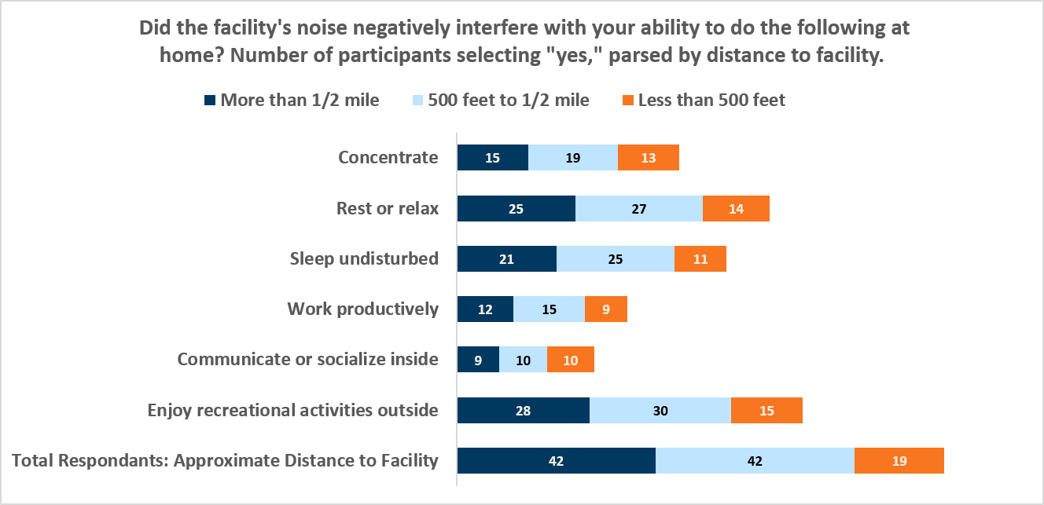
The noise has had a negative impact on respondents’ ability to enjoy their home – both inside and out
I use [sic] to look forward to going home after a long day and relax. Now I find any reason to leave just to get away from the noise. It seems to never stop.
71% reported a negative impact on their ability to enjoy the outdoors
67% have considered moving to a new home
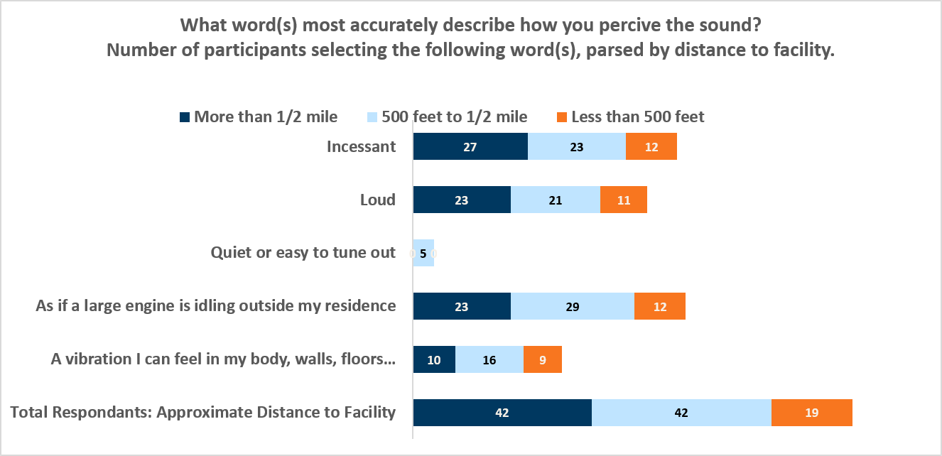
When asked to describe the noise that they heard, respondents replied:
62% “As if a large engine is idling outside my residence”
60% “Incessant”
It’s unbearable, you don’t want to hear it so you stay in your home and drown out the noise with music or tv. You feel like a prisoner in your own home.
This noise interfered with respondents’ ability to Rest or Relax (64%), Sleep Undisturbed (55%), and/or Concentrate (46%). For those that can hear the noise inside, those numbers jump to 71%, 65%, and 54% respectively.
These sorts of disturbances are more than just an annoyance. They have been linked to poor physical and mental health. This can have a negative impact on children’s ability to learn, an adult’s ability to earn a living, and a sick person’s ability to heal.
At times the noise is so loud it wakes me up at nights. I can hear it over the water in the shower. It ranges from annoying to downright ridiculous and stressful.
It isn’t just people – it is also pets and wildlife
My dogs aren’t eating as much, they are very well trained but bark all hours of the day and night (which didn’t happen prior to the power plant operating)
Over 60% of the respondents could report on behavior in pets. Of that,
68% noticed a negative change in their pet’s behavior
62% noticed a negative change in their pet’s feeding habits.
Q: Have you noticed a change in the behaviors of pets since the facility started operating?
| Negative Change | No Change | Positive Change | N/A or No Response | |
| Feeding | 40 | 22 | 2 | 39 |
| Behaviors | 40 | 17 | 2 | 44 |
87% have noticed a negative change in wildlife nearby.
Q: Have you noticed a change in the wildlife populations nearby? (If no wildlife near you, please check N/A)
| Less Wildlife | No Change | More Wildlife | N/A or No Response |
| 84 | 10 | 2 | 7 |
I am an avid birdwatcher and observed a decrease in song and appearances from species that had always been present while I lived there. Most notable were Chuck Wills Widows (used to sing at night in the woods between my house and the mine) and Wood Thrushes (used to sing all evening in those woods)
The survey also inquired about impact on livestock, but only 20% of respondents were able to comment, providing too little data for analysis.
What these findings mean for communities
This data is undergoing further analysis and will be submitted for peer review shortly. The preliminary findings add new evidence to residents’ reports that noise from data centers and cryptomining facilities is affecting quality of life and underscores the importance of accounting for noise as communities consider how and where these facilities are built. Zoning ordinances should continue to play an important role in establishing appropriate noise limits, requires compliance testing, and incorporating adequate buffers and shielding. As data center and cryptomining development continues to expand, continued research will be critical to understanding its impacts and helping communities make informed decisions.
For more information on the impacts of noise on human health – please visit: What are the impacts of noise on human health?
Special thanks to the fantastic Science for Georgia interns Olivia and Zaynah for their hard work on research and question development. Also, special thanks to the focus group that helped us to refine the survey questions.
Related News and Information
How data center noise is different from regular noise pollution | STLPR | 24 Sept, 2026
Quiet Communities and Science for Georgia Release | Press release about study | 16 Sept, 2026
‘It’s all you can hear’: New Jersey lawsuit takes on datacenter’s noise pollution | Datacenters – US | The Guardian | 28 Aug, 2026