
As many communities play whack-a-mole with data center developments, there are many locations that have sites located on interstate gas transmission lines. Given the new EPA proposed rule that would enable permitting of new energy infrastructure without public comment and with secretive developments constantly coming to light: we have reason for concern about behind-the-meter power generation.
What are their plans? From grid vulnerability to unpermitted turbine installation, Georgians deserve to know what is being planned for their state.
We know that gas turbines (powered by methane, also called ‘natural gas’) will be added to increase capacity at Georgia Power plants. Similar turbines can also be installed as behind-the-meter permanent power solutions (as seen at Colossus xAI in Memphis, TN and VoltaGrid in Covington, GA). These turbines are often used as on-site backup power generation. If the EPA ruling goes into effect, most will not need air permits and we lose yet another chance at transparency.
Crisscrossing the state are interstate gas pipelines that provide fuel for these turbines. These lines are shown in red on the map below, with the proposed SSE4 expansion shown in darker red.
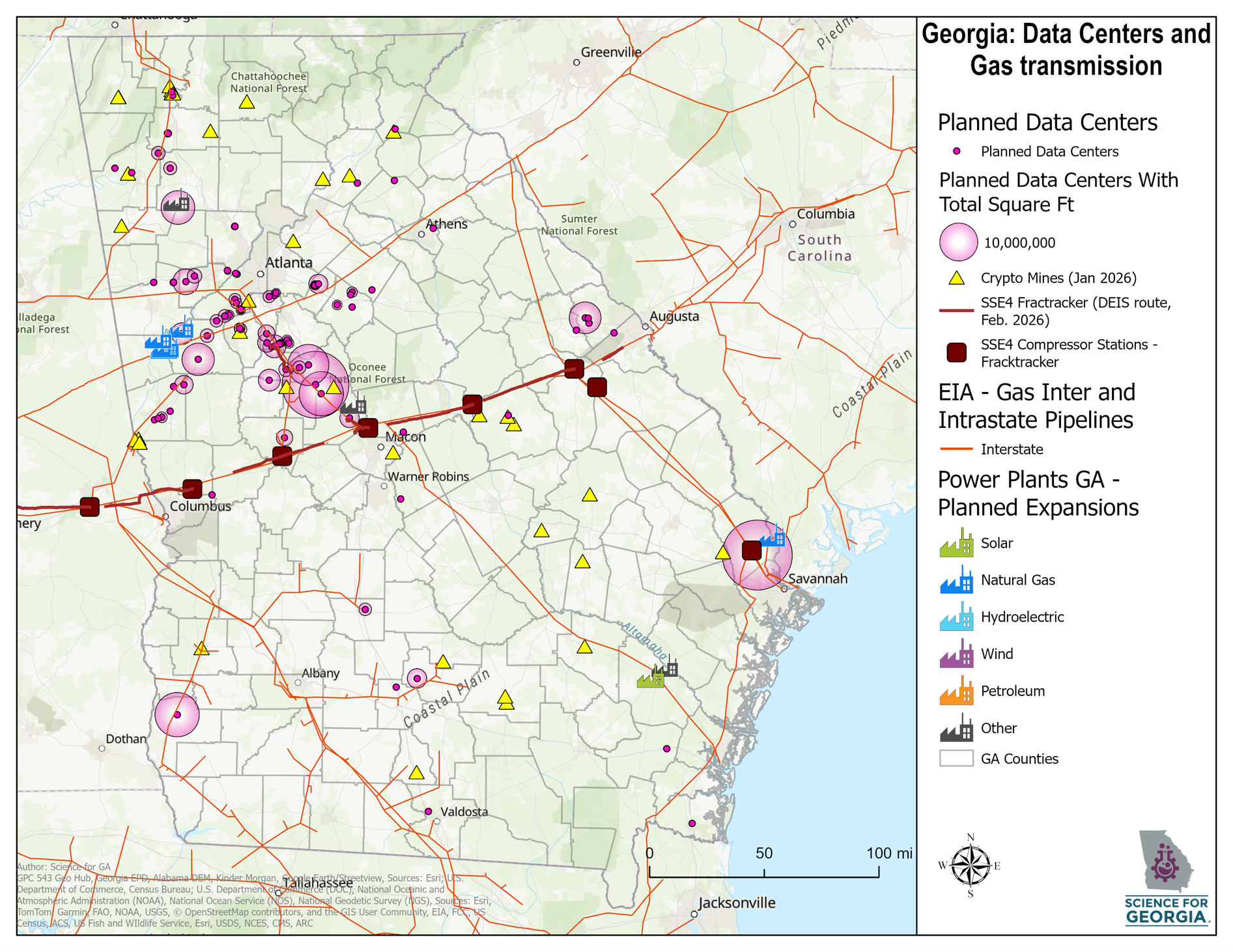
The map shows planned data centers as purple dots. Planned data centers that have reported their square footage are shown as scaled purplish circles with white centers; they range between 7,500 to 20 million square feet. Crypto mines are yellow triangles. Power plants that have announced increased capacity plans are shown as factory icons.
A pattern has emerged: many proposed data centers are clustered around the gas pipelines. This could imply that many may open “temporary” behind-the-meter turbines as Georgia Power struggles to keep up with demand.
- The newly announced OpenAI Data Center in Effingham is located near the SSE4 compressor station (which is due to be expanded).
- Other counties and projects to watch: Early (QTS), Irwin (Project Arrowhead), Tift (rumored TTY), Crisp (Project Splice), LaGrange (Amazon), Lamar (Amazon), Monroe (Forsyth Technology Campus, Google), South Fulton, Whitfield, Spalding, and Henry.
- OpenAI has hired the same people who built xAI in Memphis. Why did they do that?
- What do they plan to use before the increase in capacity is completed at McIntosh? Are they planning on the hydrogen ready gas bridge?
Pollution Impacts:
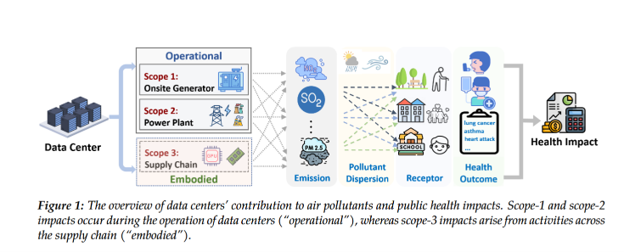
- One 2026 paper estimates that “…the total annual public health burden of U.S. data centers could exceed $20 billion in 2028 under the high-growth scenario.” (Han, et al. 2026) Pollution from on-site generation using generators or gas turbines can cause health problems such as asthma, heart attacks, and cancer. This pollution has been disproportionately affecting people of lower socioeconomic status.
- Everyone ends up paying for these health impacts: A recent U.S. Government Accountability Office report found Amazon is number 2 in the top 5 employers with employees on Medicaid, beat only by Walmart. Amazon employs around 1.5 million people, not including their contracted or temporary workers.
The 10,500 generators attached to data centers in Virginia produce enough pollution to harm public health even if used rarely, according to a new analysis of emissions permits for The Washington Post. Operating them for less than an hour per week, on average, creates the same public health impact as five power plants the size of the large Possum Point gas-fired power station near Quantico, according to the analysis by Virginia Commonwealth University and the University of Washington.
That’s enough to worsen lung and cardiovascular conditions for people in the region and cause at least three premature deaths each year, the analysis found, based on state air permits and reported emissions from the data center owners.” – The Washington Post | 28 May, 2026
Water Impacts:
- While many data center developers are saying the closed loop cooling system architecture will reduce water consumption, “Natural gas plants withdraw an average of 2,803 gallons per megawatt hour” (Energy In Depth). According to our math: a 500 MW datacenter (which is small these days) would require 33.6 MGD of water if it used a gas turbine. That much water is equivlant to the household use of 190K people (about the population size of Columbus, GA).
- What will be the impacts on Georgia’s water budgeting if data centers and their turbines become part of the grid without proper the EPA permitting process? Will we see water budgeting for watersheds become strained because of secret on site power generation? What happens during droughts if these unregulated and unpermitted gas plants go rouge?