
by Olivia Brewer and Zaynah Amir
‘Noise’ is distinct from ‘sound’ in that the term refers specifically to unwanted and/or harmful sounds.
Noise can be more than just annoying – Noise pollution can have an impact on our hearing, our physical health, our sleep, our mental health, and our children.
Despite the US Environmental Protection Agency’s (EPA) recommendation of noise limits at 55 dBA for 24-hour exposure periods and a secondary limit of 70 dBA to prevent hearing loss, around 104 million Americans are exposed to levels above 70 dBA, which is around 1 in 3 Americans (Hammer et al., 2013).
Read on to learn more about health impacts, animal impacts, and noise measurement scales.
Health Impacts of Noise
Both hearing loss and ringing in the ears (tinnitus) can be caused either by a single exposure to an intense impulse sound or by constant, long-term exposure to sounds between 75 – 85 dB, the equivalent to a vacuum cleaner or lawn mower (Basner et al., 2014; CDC 2024). Traffic-related noise accounts for a loss of more than 1.5 million healthy hearing years (Basner et al., 2014; Hahad et al., 2019).
Physically, noise can induce the body’s nervous system to release stress hormones which increases the risk of high blood pressure (Münzel et al., 2024; Münzel et al., 2017) and increases the risk of developing cardiovascular diseases such as hypertension, stroke, and heart disease. A 2020 study in Europe found that long-term exposure to environmental noise resulted in about 48,000 new cases of heart disease and 12,000 premature deaths, though these numbers are likely to be underestimated (Peris et al., 2020).
Night-time exposure to noise pollution has a higher risk of long-term health effects than day-time exposure of noise pollution (Jarup et al., 2007), due, in part, to its impact on sleep. Poor sleep impacts day-time and cognitive functioning, performance, and mood. This has been linked to an increased risk of hypertension and cardiovascular diseases, metabolic disease, and mental health issues (Münzel et al., 2024; Basner et al., 2014; Jarup et al., 2007; Chasens et al., 2021; Scott et al., 2021; Khan & Al-Jahdali, 2023).
Noise pollution can also affect mental health mainly through a rise in annoyance, stress, and negative emotional responses. Noise disturbs and interferes with daily activities, leading to anger, displeasure, and stress which can cause a lowering in reported quality of life (Basner et al., 2014; Dratva et al., 2010) cardiovascular complications (Hahad et al., 2019) and major depression (Dhar and Barton, 2016; Münzel et al., 2024).
For children, exposure to noise can have lifelong consequences including permanent hearing impairment and decreased cognitive performance. Hearing impairment and poor sleep have negative impacts on children’s communication abilities, ability to pay attention, and emotional regulation, which all lead to decreased learning outcomes (Basner et al., 2014). Additionally, children may be more likely to accumulate stress due to a potential lack of effective coping mechanisms (Basner et al. 2014).

Impact on Animals
The impact of noise pollution spreads beyond humans; research shows that across animal species, the response to noise is generally uniform (Kunc and Schmidt, 2019). In animals, noise can disrupt communication, homeostasis, and foraging abilities; additionally, noise pollution can lead to displacement of wildlife and lower reproductive success, which can put a strain on certain species (Kunc and Schmidt, 2019; Hemmat et al., 2023).
A Brief Intro to Sound
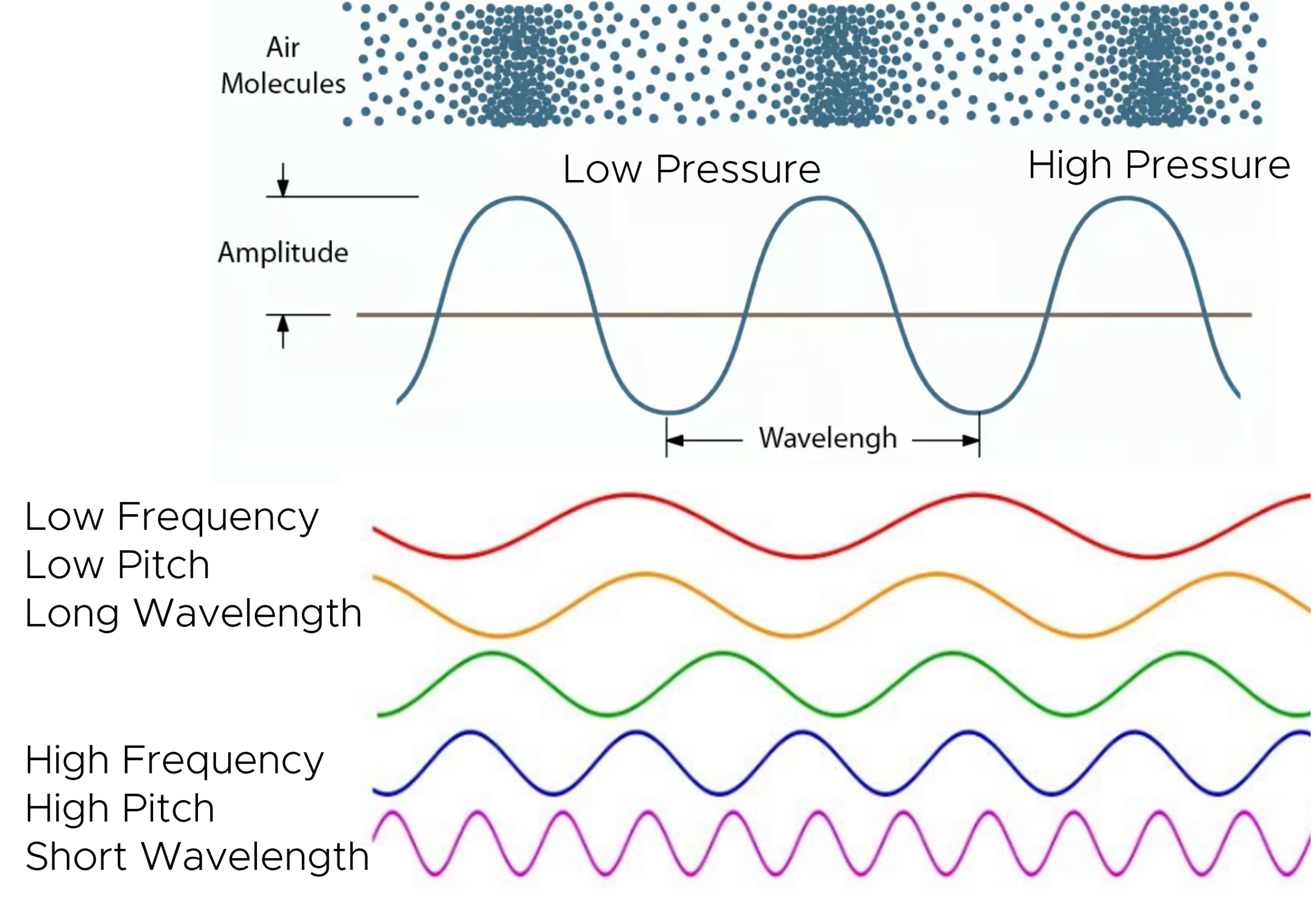
Sound consists of waves moving through matter, including solids, liquids, and gases (Shipman et al., 2021). In air, sound waves are made up of alternating high-pressure and low-pressure regions as particles compress and then spread apart. The frequency of a sound, measured in Hertz (Hz), refers to the number of wave cycles that occur per second. Differences in frequency are perceived by the human ear as differences in pitch, with higher frequencies being perceived as higher-pitched sounds. Humans typically are able to perceive sounds with frequencies ranging from 20 to 20,000 Hz (Shipman et al., 2021).
Although meant for children, these videos help explain the science behind sound:
Types of Noise
Noise is classified as unwanted and/or harmful sounds (Fink, 2019). According to Cirrus Research, noise can be categorized as continuous, intermittent, impulsive, and low-frequency.
Continuous noise, such as that produced by factory machinery, engines, and HVAC systems, is noise that occurs continuously at approximately the same volume, tone, and frequency.
Intermittent noise is defined as noise levels that rapidly increase and decrease; examples of intermittent noise include passing trains and planes and machinery that operates cyclically.
Impulsive noises are sudden bursts of unexpected, and oftentime startling, noise such as gun shots, explosions, and construction noise.
Low-frequency noise, such as that from power stations and diesel engines, are the most difficult type to mitigate and can travel for miles. (Tolliday, 2026). It is sometimes not heard, but rather felt—a low-level hum. Exposure to man-made low-frequency noise is common in today’s world, especially in urban environments (Berglund et al., 1996)
Measuring Noise
Sound intensity is measured in decibels (dB), which operate on a logarithmic scale; this scale more accurately represents how changes in sound intensity are perceived as changes in loudness by the human ear (How is sound measured?, 2025).
The A-weighted decibel scale (dBA) is commonly used when discussing the safety of noise levels, because it accounts for the intensity, frequency (pitch), and what the human ear can perceive. For example, low frequency sounds below the range of typical human hearing will produce a lower dBA reading than a dB reading because the ear does not perceive the frequency of the sound effectively (How is sound measured?, 2025).
The widespread use of the A-weighted decibel scale by regulatory bodies leads to an understating of noise impact when a majority of the noise is low frequency. According to the World Health Organization, because low frequency sounds are weighted as “less important” than mid- and high-frequency sounds (Berglund et al., 1999, p. viii), “when prominent low-frequency components are present, noise measures based on A-weighting are inappropriate” (Berglund et al., 1999, p. xiii).
Previous experiments have illustrated this effect, showing that the A-weighted scale underestimates the loudness and annoyance of low-frequency sounds. Studies by (Kjellberg et al.,1984 and Nilsson, 2007 both found that sounds at the same or similar dBA levels were deemed louder and more annoying by participants when they consisted of more low-frequency components.
To avoid this issue, researchers have proposed using a C-weighted scale (dBC), which measures a wider range of frequencies and more effectively picks up low-frequency noise (Knauert et al., 2017). According to the Occupational Safety and Health Administration (OSHA), C-weighting utilizes a “flat” measurement scale that includes the low frequencies that the A-weighted scale does not capture. Because of this, the C-weighted scale can be used for evaluating hearing protection as well as low-frequency sounds that induce vibrations in buildings.
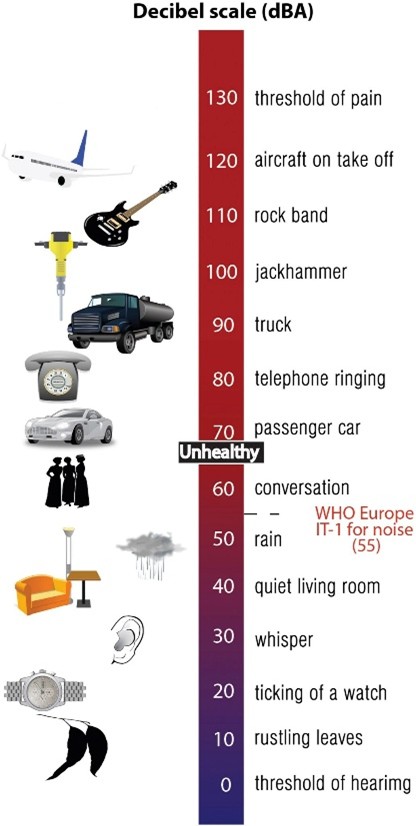
Sound intensity is measured in decibels (dB), which operate on a logarithmic scale; this scale more accurately represents how changes in sound intensity are perceived as changes in loudness by the human ear (How is sound measured?, 2025).
References
Alvarez, Maximillian. (Host). (2025, April 23). A bitcoin mine in Texas is ‘killing us slowly,’ local residents say [Audio podcast episode]. In Working People. https://www.youtube.com/watch?v=9KyIOJwqOjI
Baliatsas, C., van Kamp, I., van Poll, R., & Yzermans, J. (2016). Health Effects from Low-Frequency Noise and Infrasound in the General Population: Is it Time to Listen? A Systematic Review of Observational Studies. Science of The Total Environment, 557–558, 163–169. https://doi.org/10.1016/j.scitotenv.2016.03.065
Basner, M., Babisch, W., Davis, A., Brink, M., Clark, C., Janssen, S., & Stansfeld, S. (2014). Auditory and Non-Auditory Effects of Noise on Health. The Lancet, 383(9925), 1325–1332. https://doi.org/10.1016/s0140-6736(13)61613-x
Basner, M., & McGuire, S. (2018). WHO Environmental Noise Guidelines for the European Region: A Systematic Review on Environmental Noise and Effects on Sleep. International Journal of Environmental Research and Public Health, 15(3), 519. https://doi.org/10.3390/ijerph15030519
Berglund, B., Hassmén, P., & Job, R. F. (1996). Sources and effects of low-frequency noise. The Journal of the Acoustical Society of America, 99(5), 2985–3002. https://doi.org/10.1121/1.414863
Berglund, B., Lindvall, T., & Schwela, D. A., Guidelines for Community Noise (1999). World Health Organization.
Carvell, T. (2023, June). Williams Co. Residents Frustrated by Lack of Action on Crypto Mine, State Says it’s a Local Issue. KFGO. https://kfgo.com/2023/06/25/williams-co-residents-frustrated-by-noise-from-lack-of-action-on-crypto-mine/
Chasens, E. R., Imes, C. C., Kariuki, J. K., Luyster, F. S., Morris, J. L., DiNardo, M. M., Godzik, C. M., Jeon, B., & Yang, K. (2021). Sleep and Metabolic Syndrome. The Nursing clinics of North America, 56(2), 203–217. https://doi.org/10.1016/j.cnur.2020.10.012
Chow, A. R. (2024, July 16). “We’re Living in a Nightmare:” Inside the Health Crisis of a Texas Bitcoin Town. Time. https://time.com/6982015/bitcoin-mining-texas-health/
Dratva, J., Zemp, E., Dietrich, D. F., Bridevaux, P.-O., Rochat, T., Schindler, C., & Gerbase, M. W. (2010). Impact of Road Traffic Noise Annoyance on Health-Related Quality of Life: Results from a Population-Based Study. Quality of Life Research, 19(1), 37–46. https://doi.org/10.1007/s11136-009-9571-2
Facing a Growing Crypto-Mining Sector, the U.S. to Require Reports of Power Use by Miners. EUCI. (2024, February 14). https://www.euci.com/facing-a-growing-crypto-mining-sector-the-u-s-to-require-reports-of-power-use-by-miners/
Fink, D. (2019). A New Definition of Noise: Noise is Unwanted and/or Harmful Sound. Noise is the New ‘Secondhand Smoke’. Proceedings of Meetings on Acoustics, 39, 050002. https://doi.org/10.1121/2.0001186
Fitzpatrick, A. (2025, December 1). America’s Data Center Growth Hot Spots, Mapped. https://www.axios.com/2025/12/18/data-center-growth-map-states
Hahad, O., Bayo Jimenez, M. T., Kuntic, M., Frenis, K., Steven, S., Daiber, A., & Münzel, T. (2022). Cerebral Consequences of Environmental Noise Exposure. Environment International, 165, 107306. https://doi.org/10.1016/j.envint.2022.107306
Håkansson, L., & Worth, J. (2022, April 21). Extremely quiet fans can improve our health. Chalmers. https://www.chalmers.se/en/current/news/m2-extremely-quiet-fans-can-improve-our-health/
Haile, L. M., Orji, A. U., Reavis, K. M., Briant, P. S., Lucas, K. M., Alahdab, F., Bärnighausen, T. W., Bell, A. W., Cao, C., Dai, X., Hay, S. I., Heidari, G., Karaye, I. M., Miller, T. R., Mokdad, A. H., Mostafavi, E., Natto, Z. S., Pawar, S., Rana, J., Seylani, A., … GBD 2019 USA Hearing Loss Collaborators (2024). Hearing Loss Prevalence, Years Lived With Disability, and Hearing Aid Use in the United States From 1990 to 2019: Findings From the Global Burden of Disease Study. Ear and hearing, 45(1), 257–267. https://doi.org/10.1097/AUD.0000000000001420
Hammer, M. S., Swinburn, T. K., & Neitzel, R. L. (2014). Environmental noise pollution in the United States: developing an effective public health response. Environmental health perspectives, 122(2), 115–119. https://doi.org/10.1289/ehp.1307272
Hemmat, W., Hesam, A. M., & Atifnigar, H. (2023). Exploring Noise Pollution, Causes, Effects, and Mitigation Strategies: A Review Paper. European Journal of Theoretical and Applied Sciences, 1(5), 995–1005. https://doi.org/10.59324/ejtas.2023.1(5).86
House, K. (2026, February 2). Data Center Moratoriums Pile Up in Michigan. No One Knows if They’ll Work. Bridge Michigan. https://bridgemi.com/michigan-environment-watch/at-least-19-michigan-towns-pause-data-centers-no-one-knows-if-itll-work/
Jarup, L., Babisch, W., Houthuijs, D., Pershagen, G., Katsouyanni, K., Cadum, E., Dudley, M.-L., Savigny, P., Seiffert, I., Swart, W., Breugelmans, O., Bluhm, G., Selander, J., Haralabidis, A., Dimakopoulou, K., Sourtzi, P., Velonakis, M., & Vigna-Taglianti, F. (2008). Hypertension and Exposure to Noise Near Airports: The HYENA Study. Environmental Health Perspectives, 116(3), 329–333. https://doi.org/10.1289/ehp.10775
Khan, M. A., & Al-Jahdali, H. (2023). The consequences of sleep deprivation on cognitive performance. Neurosciences (Riyadh, Saudi Arabia), 28(2), 91–99. https://doi.org/10.17712/nsj.2023.2.20220108
Kjellberg, A., Goldstein, M., & Gamberale, F. (1984). An assesment of db(A) for predicting loudness and annoyance of noise containing low frequency components. Journal of Low Frequency Noise, Vibration and Active Control, 3(3), 10–16. https://doi.org/10.1177/026309238400300302
Kunc, H. P., & Schmidt, R. (2019). The Effects of Anthropogenic Noise on Animals: A Meta-Analysis. Biology Letters, 15(11), 20190649. https://doi.org/10.1098/rsbl.2019.0649
Lynch, T. (2023, August 15). Neighbors Frustrated with Bitcoin Mine in North Tonawanda. WIVB 4. https://www.wivb.com/news/local-news/niagara-county/north-tonawanda/neighbors-frustrated-with-bitcoin-mine-in-north-tonawanda/
Meeson, S. (2025, February 6). Noise, nightmares, panic attacks: When bitcoin miners move next door. The Paraguay Post. https://www.theparaguaypost.com/p/noise-bitcoin-cryptocurrency-paraguay-villarrica
Münzel, T., Daiber, A., Steven, S., Tran, L. P., Ullmann, E., Kossmann, S., Schmidt, F. P., Oelze, M., Xia, N., Li, H., Pinto, A., Wild, P., Pies, K., Schmidt, E. R., Rapp, S., & Kröller-Schön, S. (2017). Effects of noise on vascular function, oxidative stress, and inflammation: mechanistic insight from studies in mice. European heart journal, 38(37), 2838–2849. https://doi.org/10.1093/eurheartj/ehx081
Münzel, T., Molitor, M., Kuntic, M., Hahad, O., Röösli, M., Engelmann, N., Basner, M., Daiber, A., & Sørensen, M. (2024). Transportation Noise Pollution and Cardiovascular Health. Circulation Research, 134(9), 1113–1135. https://doi.org/10.1161/circresaha.123.323584
National Institute on Deafness and Other Communication Disorders. (2025, April 28). How is sound measured? https://www.nidcd.nih.gov/health/how-sound-measured
Niemeyer, L. (2023, October 9). In a Rural Kentucky Community, the Roar of a Suspected Crypto “Mine” Never Ends. Kentucky Lantern. https://kentuckylantern.com/2023/10/09/in-a-rural-kentucky-community-the-roar-of-a-suspected-crypto-mine-never-ends/
Nilsson, M. E. (2007). A-weighted sound pressure level as an indicator of short-term loudness or annoyance of road-traffic sound. Journal of Sound and Vibration, 302(1–2), 197–207. https://doi.org/10.1016/j.jsv.2006.11.010
Pambudi, N. A., Sarifudin, A., Firdaus, R. A., Ulfa, D. K., Gandidi, I. M., & Romadhon, R. (2022). The Immersion Cooling Technology: Current and Future Development in Energy Saving. Alexandria Engineering Journal, 61(12), 9509–9527. https://doi.org/10.1016/j.aej.2022.02.059
Peris, E., Blanes, N., Fons, J., de la Maza, M. S., Ramos, M. J., Domingues, F., Biala, K., Peterlin, M., Ganzleben, C., & Adams, M. European Union. (2020). Environmental Noise in Europe (22/2019). European Environmental Agency.
Peters, K. (2024, July 10). Texas leaders worry that bitcoin mines threaten to crash the state power grid. Inside Climate News. https://insideclimatenews.org/news/10072024/texas-bitcoin-mining-threatens-power-grid/
Ringsak, E. W. M. (2025, December 9). Data Centers are Not Good Neighbors. WV News. https://www.wvnews.com/news/around_the_web/states/sheehy-hasnt-live-up-to-midshipmens-honor-code/article_1baf3f29-bcc2-522b-b958-79f120d4e001.html
Sattler, L. (2025, June 5). Concerning new report reveals hidden health risks of cryptocurrency mining: “I can feel it in my chest.” The Cool Down. https://www.thecooldown.com/green-business/cryptocurrency-mining-noise-community-health/
Schad, I. (2023). Common Pitfalls and Potential Solutions for Crypto-Currency Mining Facility Noise. Ingenta connect. https://www.ingentaconnect.com/contentone/ince/incecp/2023/00000266/00000002/art00034?crawler=true&mimetype=application/pdf
Scott, A. J., Webb, T. L., Martyn-St James, M., Rowse, G., & Weich, S. (2021). Improving sleep quality leads to better mental health: A meta-analysis of randomised controlled trials. Sleep medicine reviews, 60, 101556. https://doi.org/10.1016/j.smrv.2021.101556
Shipman, J. T., Wilson, J. D., Higgins, C. A., & Lou, B. (2021). An Introduction to Physical Science (15th ed.). Cengage.
Takefuji, Y. (2025). Understanding environmental noise: Transmission, attenuation, resonance and health implications. Green Technologies and Sustainability, 3(3). https://doi.org/10.1016/j.grets.2025.100215
Tolliday, J. (2026, February 16). What are the 4 Different Types of Noise?. Cirrus Research plc. https://cirrusresearch.com/4-different-types-noise/
Tx Const. Sec. 42.01. https://statutes.capitol.texas.gov/?tab=1&code=PE&chapter=PE.42&artSec=
USA Data Centers. Data Center Map. (n.d.). https://www.datacentermap.com/usa/
Weir, B. (2023). How the Blare of a Crypto Mine Woke up Murphy, NC . Local 3 News. https://www.local3news.com/regional-national/how-the-blare-of-a-crypto-mine-woke-up-murphy-nc/article_4c4bf7bb-049e-59f4-8bda-b53b17e8a769.html
Yan, W. (2023, January 5). The Unrelenting Roar of a Crypto Mine Tore this Town Apart. Popular Mechanics. https://www.popularmechanics.com/science/health/a42011194/crypto-mine-noise-murphy/