
by Hannah Bacho
This is the time to stand up for your community and not underestimate how important it is to commit to doing something truly impactful for your community. Remember to dream big and think about what you want—not what you will settle for.
Community Benefits Agreements or Ordinances give residents directly impacted by new data centers and AI developments a voice for meaningful change in local policy. These legally binding agreements organize relevant community concerns to drive action and to leverage the increased economic opportunities presented by data center facilities to support improvements in local infrastructure, education, and civic opportunities (Federation of American Scientists). We must continue to advocate for ourselves to ensure large corporations do not continue to take advantage of or completely disregard the concerns of residents near new developments. Open communication with developers around structured, legally-binding agreements fosters positive relationships that can lead to ongoing support that benefits all involved parties.
Many people are asking for a Community Benefit Agreement or Ordinance. But what are they? How do you create one? Who is involved? This toolkit aims to provide an overview and also provides links to more in-depth resources.
Important Definitions
- Community Benefits Agreement (CBA): Legally binding agreement between an incorporated community coalition, non-profit, or other grassroots organization and the developer describing the industry’s commitments and benefits for the local community (Economic Policy Institute). The private agreement can be negotiated between the impacted community, local governments, and the developer to establish court-enforceable benefits covering specific priorities and needs. More than one agreement may need to be developed between each community group and the developer within a region Kevin Bryan, Equnival Partners).
- Community Benefit Ordinance (CBO): Legally binding law that can be applied across multiple communities within a defined jurisdiction. These regulations require new projects that meet certain criteria to follow the contract requirements outlined by the local government. New communities that are established are often protected under local community benefit ordinances, but it is important to reference established ordinances, as this varies on a case-by-case basis. (Anti-Displacement Network).
- Community Benefit Plan (CBP): Non-legally binding agreements often constructed by the developer and presented to federal government organizations representing community groups, outlining anticipated benefits from the proposed project. Typically used to facilitate funding eligibility from the federal government and efforts for company engagement with residents or community groups (Economic Policy Institute). CBPs can be a great starting point for expansion and refinement when developing a CBO or CBA.
- Community Workforce Agreement (CWA): Legally binding agreement that is primarily centered around benefits for the community’s workforce, such as labor unions and the developer. These private agreements can be formed either as a result of or in conjunction with the Community Benefits Agreement (CBA); however, CWAs are not frequently utilized across Georgia because union membership is much less than the United States average (Workforce GPS).
| Agreement Type | Legally Binding? | Who is primarily involved in the agreement? |
| Community Benefits Agreement (CBA) | YES | Nonprofits and/or incorporated community coalitions |
| Community Benefits Ordinance (CBO) | YES | Local Government |
| Community Benefits Plan (CBP) | NO | Govt organizations, development authorities, or appointed individuals. |
| Community Workforce Agreement (CWA) | Yes, but it can be challenging to implement in Georgia due to state prohibitions | Specific Labor Unions |
Important Note: It is crucial that any agreement must not be bound by a Non-disclosure Agreement (NDA). If any problem, disagreement, or issue is not properly addressed by the developer, then corrective actions cannot be implemented or legally enforced because of the NDA signature.
Some land use legal terms:
- Zoning: In most counties and municipalities, land is zoned for a specific use. Examples include: residential, agricultural, commercials, and industrial. When applying for a building permit, a new development must fit definition of types of uses allowed in that zone.
- Conditional use permits (CUP): Developments in specific zones must follow the laws and regulations in place for specific activity; however, industries may request special permission for the construction of a project that is atypical in a specific zoning district. A part of the agreement requires the developer or requester to follow additional conditions (also may be referred to as a special use permit or special exception) (Adobe).
- What this means: When a data center owner requests a conditional use permit, a public hearing is required with the zoning board or county commissioners. However, if the special conditions are not properly fulfilled, these permits can be revoked (AI Now).
- Developments of Regional Impact Reviews (DRI): Projects that are large-scale and may have significant impacts on the surrounding jurisdictions and communities are required to submit DRI paperwork. Reviews of these properties are conducted before construction begins to assess the potential downstream effects or implications. Data centers over 300,000 sq feet (inside Atlanta) and 500,000 sq feet (outside Atlanta) must submit DRI paperwork. (Georgia Department of Community Affairs).
- What this means: Large, hyperscale data centers are subject to DRIs because of the land footprint the projects demand. Community members can view this as a public record and access recent DRI Submissions in Georgia for multiple projects.
- Rezoning and variance hearings: Rezoning refers to the changing of the classification of an area of land to either residential, agricultural, industrial, mixed-use, commercial, or historic/special use. A variance is permitted if there is a special exception to the regulations, like difficulty building in a specific zone or hardship (Southwest Georgia Regional Commission).
- What this means: If an area needs to be rezoned to accommodate an industrial project like a data center, there must be a public notice or a hearing to present the information. Community members can attend and present public comments within a specified time frame after a new proposal is presented (EJ Greenbook, pg. 335).
- Moratoriums: A temporary delay in permit and application approvals that can last between 6 and 12 months (Fight a Data Center Reference Glossary).
- What this means: A moratorium can provide valuable time needed to revise and update local or state regulations before new industrial projects can proceed to construction. Hesitancy about the potential implications of a data center project often triggers moratoriums to be passed.
More information on legal terms related to data center development can be found in the Fight a Data Center Reference Glossary.
What is typically in a CBA/CBO?
In any formal agreement, community stakeholders, supporting groups, and developers collaborate to establish goals and measurable benefits that they believe will best support their specific community needs. There are several mechanisms and commitments that communities can advocate for that are reasonable and achievable, depending on funding and committed investments from the developer. It is crucial to include language that establishes methods of reporting accountability and the responsible party that conducts enforcement actions. We have highlighted below examples from the NAACP Community Benefits Agreement Template that are specific to data center projects (many thanks to the NAACP!)
The following are the bare minimum that should be expected of any developer applying for and receiving a permit to build any new facility. These should be included in any zoning and development ordinance.
- Construction Agreements:
- In the initial planning stages and before breaking ground, agreements can be established to create fair local job opportunities during construction and throughout operation
- General compliance with local ordinance and zoning laws established by the local government
- Proper disclosure and required impact assessments relating to land disturbance, new energy demands, power lines and substation locations, water use permits, waste disposal protocols, emergency procedures, and/or impact on nature and wildlife
- Planned mitigation and revitalization strategies to ensure the protection of human health and the environment, such as residential buffering, sound barriers, water quality testing, and landscaping
- Operation Compliance:
- Continued compliance with all local, state, and federal laws throughout operation and decommissioning procedures
- Establishing required and recurrent testing for annual certifications and inspections not required by the local government or state laws.
- Timeline creation for the anticipated delivery of benefits back to the community once an agreement is reached
- Environmental health testing and monitoring across the site and neighboring areas. Can specify independent testing procedures for areas of frequent concern, including noise, light, emissions, and water quality, ideally funded by the developer.
- Reporting:
- Implementing, regularly scheduled, publicly disclosed independent reviews for compliance testing and audits
- Explain how reporting is conducted, what is reported, by whom, and how frequently it is submitted for review
- Description of the allocation of funds that the community will receive and how disbursements are broken down over a period of time
The following are what make an ordinance or agreement for the community stand out—these are on top of meeting bare minimum construction and zoning regulations—and instead get to the heart of a development being in conjunction with and service to the surrounding community.
- Community Engagement:
- Encourage implementation of community information sessions or communication platforms provided by the developer to update the public on ongoing development activities and progress reports.
- Promote educational training programs or internships designed to increase human capacity for STEM fields and to understand the future of AI technology, hosted or funded by developing companies
- Definable employment opportunities that focus on hiring local labor forces responsible for the maintenance of facilities or during construction phases of other projects.
- Financial Contributions:
- Established Community Benefit Fund with discretion of usage designated to the community coalition or sponsoring party, such as a recognized non-profit group. Available funds can support projects that benefit the entire community, selected non-profit groups, or finance the community’s coalition group.
- This is where communities can get creative to meet their unique needs. Funds can support paying a local CBA/CBO enforcement officer, medical centers, weatherization of homes, college scholarships, STEM curriculum, and facility upgrades.
- Infrastructure or Land Revitalization:
- With the demands of new facilities, new revitalized infrastructure may be needed to support the needs of the site project, additionally benefiting the local community. Examples of this can include strengthening the power grid, new roadways, or water treatment facilities, which can be funded by the developer. At the bare minimum, anticipated taxpayer costs must be made transparent.
- If the proposed development area is a designated hazardous waste site, the developer may take on remediation responsibilities or designate funding to ensure environmental protection and mitigate human health impacts.
- Resource Usage Agreements
- Developers establish boundaries of energy and/or water use, created through consultation with local utility providers or Georgia Power—focusing on normal operation and changes needed during times of duress (droughts, severe storm recovery, etc.)
- Encourage the use of renewable energy or the development of new infrastructure to support this demand, such as solar grids or battery power
- Documentation of the generator machinery and operation, along with limitations on how often they are utilized for emission records (Federation of American Scientists)
- Environmental Protections
- Lead independent environmental health studies to examine the impact of data center operations on surrounding communities and land to contribute novel findings to the field.
- Annual reporting of sustainability initiatives and investments back into the local community
- Acknowledgement, reporting, and remediation of significant environmental impacts, such as carbon emissions, energy usage, or disturbance to local wetland ecosystems, each year.
- Defining a community (CBA) or jurisdiction (CBO):
- It is important to include language that clearly defines a specific neighborhood area or community group in a private CBA to avoid disagreements over fund disbursements
- Within a CBO, clearly define a jurisdiction or census tracts in which future developments that meet certain criteria must abide by the approved benefit requirements. The criteria that the new planned development must fulfill can be discussed with local government leaders and county commissioners
- Accounting for future amendments:
- To ensure an agreement maintains its legal power, it is necessary to include statements that allow for future considerations and amendments as communities change and grow. This safeguard is simple, but it can be very effective to ensure the benefits do not become obsolete or irrelevant over time.
- Identifying enforcement personnel and establishing outcomes:
- Once a CBA or CBO is written and implemented, it can be challenging to ensure that developers are being held accountable and that monitoring practices are being followed. To account for this, identify specific community members or professional personnel to step in when necessary. A creative use of the community benefit funds can be to pay the “enforcement officer.” Procedures that are laid out for enforcement and legal action, such as submitting an audit or official notice to identified authorities, provide clear and meaningful information to all parties involved.
- Defining established outcomes or reasonable legal actions ensures accountability. Resulting retributions after identifying a violation can include penalty payments to the community for benefit funds, audit requests, litigation, or even permit termination if repeated offenses occur.
Who should contribute to building your CBA/CBO?
Designing and implementing a CBA or CBO is based on active collaboration and requires input from several different parties throughout the entire process, and early involvement is key to building these relationships. Having multiple groups involved in the community coalition is complicated and likely will involve some level of disagreement and conflict, which is a natural part of the discussion process. Resources for navigating conversations meaningfully and respectfully are provided in the Establishing a Trusted Team section of this toolkit.
Community groups and coalitions can be made up of several different individuals or organizations who may be directly or indirectly affected by a new data center development. Establishing a unified coalition is beneficial for successful planning; however, it is important to recognize that every individual contributes diverse and specialized personal experiences. Reaching out to individuals within the following groups can be an excellent place to start the conversation about planned data centers proposed for your area. Keep in mind that to maintain a strong and long-lasting relationship, these individuals or groups should be invited into the process, or resistance and opposition may stall progress down the road.
- Neighborhood Planning Units or Neighborhood Associations: These are neighborhood-specific citizen councils that often meet on a regular basis to discuss city updates, improvements, and resident concerns. Citizen officials of these communities can then present suggestions to the city council members (City of Altanta, GA).
- Grassroots organizations: Community or volunteer-based organizations that can be founded and organized to address various local issues, such as environmental health, conservation, and human rights (Plural Policy)
- Local workforce groups: Company employees or labor unions that can advocate on behalf of fair working conditions for the community. They can serve as local experts for understanding labor commitments, providing opportunities for underserved workers, negotiating fair payments, and providing proper training (We Build Progress).
- Faith-Based Organizations – Local faith communities are often connected to the ‘pulse’ of a community and have a built-in level of trust. Connecting with a few faith-based organizations may provide a way to connect with multiple different communities in a trusted manner.
A community coalition and stakeholders often require the support and expertise of legally registered or recognized organizations. Reaching out to specialists or professionals can be a means for obtaining funding and crucial resources that may be required for legal consultation or advice.
- County Commissioners: Responsible for many land use regulations, zoning ordinances, and moratoriums concerning new developments like data centers. Local legislators are well-versed in the formal language needed to draft policies and are familiar with local and state laws and legislation (Association County Commissioners of Georgia)
- County Planning Departments: Responsible for zoning and future use plans that are codified into law by the Planning Commissioners and County Commissioners. Every county lists commissioners on its government website with contact information. To find your local commissioner, refer to the Reach out to elected officials section of this toolkit.
- State Legislators: Elected officials who make up the House of Representatives and the State Senate. Getting in contact with these representatives may be helpful if you wish to pursue a statewide ordinance or law relating to data center operation and construction requirements. Find out more about how to contact them on the Georgia.gov Contact State Legislators
- Academic Institutions: Professors and researchers within universities are knowledgeable about data collection and interpretation. This skill is particularly useful when understanding how data center facilities have the potential to impact human health and the environment.
- Non-profit organizations: Members and leaders of local non-profits can provide support or representation for a community benefits agreement, as they have expertise in cultivating community, capacity building, and potential funding resources or locations (Kevin Bryan).
- Utility Providers: With demands for increased water and energy requirements and possible infrastructure revitalizations, utility contractors may contact residents who could be affected by changes in rates or who will experience construction near or on their property. Undisclosed figures and a lack of transparency have led to opposition from community members. It may be necessary to reach out to local providers regarding planned developments.
Developers initiate conversations about zoning and apply for permits for construction projects with the local government officials in the early planning stages. Ideally, industry leaders and developers will also reach out to affected neighborhoods and communities for engagement and provide information sessions about how the new project will impact or support the community. However, initiation from community groups may be necessary to request information. This is often in the form of a Community Benefit Plan, which can be negotiated into legally binding agreements (Kevin Bryan). The following personnel may engage with communities and serve as representatives or intermediaries:
- Corporate liaisons: Representatives in the specific industry facilitating a new data center project. These personnel may facilitate community engagement workshops, panels, and focus group sessions to share information about the site and answer questions regarding resident concerns. Websites may also be created to provide brief facts and frequently asked questions, where contact information is listed for the company team (NREL, NLR).
- Public Relations Agencies: Partners or external parties collaborating with data center developers who may facilitate media coverage of new developments (Jaymie Scotto & Associates).
Developing CBAs/CBOs Specific to Data Centers
Get Organized and Educated
his is the time to stand up for your community and not underestimate how important it is to establish a team that is committed to doing something truly impactful for your community. Remember to dream big and think about what you want—not what you will settle for.
Finding community members, neighbors, and local organizations with common interests or goals is influential for inspiring positive change and gaining buy-in from as many as possible. Even more important is having a diverse group with members from all walks of life, contributing unique lived experiences that can fulfill roles across the community coalition. Reinforce your group with a breadth of knowledge and know-how to ensure you can navigate misinformation and avoid manipulation by project developers. Starting as early as possible (ideally before construction is proposed) provides the most flexibility and time to allow the best chance at establishing a powerful community benefits document (Federation of American Scientists).
Having a strong foundation built on a unified purpose and shared concern allows for longevity and resilience as pushbacks and challenges are presented throughout the drafting and negotiation process. Refer to this Data Center Organizing Toolkit, which discusses the essentials for community meetings, organizing talking points, and taking action! Brief suggestions and additional resources for organizing a trusted team are outlined below.
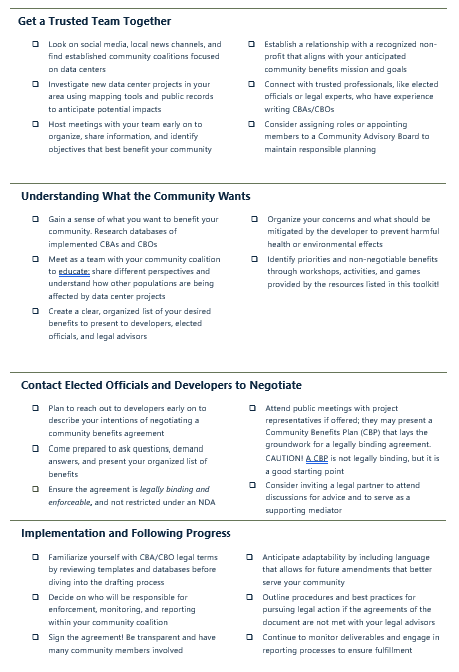
- Reaching out in your area and beyond:
- Local newspapers and news outlets are an excellent place to search for active campaigns and organizations expressing interest in new data centers. Search through recent articles to see if there are any petition signing events, upcoming townhalls, or public hearings to attend and inquire about organizing a coalition group for a CBA or CBO.
- Find active coalitions in your area using the Community Organizations Focusing on Data Centers map
- Social media can help identify interest groups in your area. Facebook, Substack, Reddit, and Discord are a few examples of platforms where people can join a group to discuss current issues, complaints, or positive news regarding new projects.
- Contact local community groups with which you have an established relationship. This can help identify individuals you are comfortable communicating and working with, but it is important to ensure that your coalition is accurately representing the interests and views of the affected community.
- Explore power mapping techniques to explore potential supporting members within your community (Power Mapping 101).
- Connect with trusted professionals who have experience writing CBAs or ordinances for advice. These professional groups can be private entities, attorneys, government officials, or lawyers. Consult org to find legal help on specific issues and referrals.
- Establish a relationship with a recognized non-profit. This may be necessary to ensure your CBA or CBO is adequately and legally represented, and funds are properly managed (Taufiq et al., 2026). Funds supplied by the developer through a CBA can be distributed to your community through this partnership. Find local non-profits using the GreatNonprofits search tool that align with your mission and interests.
- Local newspapers and news outlets are an excellent place to search for active campaigns and organizations expressing interest in new data centers. Search through recent articles to see if there are any petition signing events, upcoming townhalls, or public hearings to attend and inquire about organizing a coalition group for a CBA or CBO.
- Host meetings and discussions with your team early to organize and identify objectives
- Establish a meeting schedule that works with your group and can accommodate long-term commitments, as the writing process, drafting, and negotiation efforts can take several months before the document is complete.
- Fair Shake has a wide variety of Agendas for Community Education and Meeting development resources, suggestions, and templates that you can use to plan and develop meeting agendas and discussion topics
- Recognize that everyone may not be on the same page. Consider all opinions and anticipate some disagreements throughout the process but take it as an opportunity to learn and adjust course when necessary.
- Provide a brief overview of what CBA and CBOs are and how they are designed by community members to better serve their own community, referring to sections of this toolkit or any of the databases listed below in the Directory for outreach and education.
- Refer to this excellent Community Tool Box resource for navigating a wide range of potential challenges within a community coalition
- Also check out this Learn to Advocate Guide from Science for Georgia
- Consider assigning roles or appointing members who will represent the coalition group and act as the governing body for decisions. This executive team may be referred to as the Community Advisory Board or another group name throughout the CBA or CBO document (NAACP).
- Establish a meeting schedule that works with your group and can accommodate long-term commitments, as the writing process, drafting, and negotiation efforts can take several months before the document is complete.
In addition to building a trusted team, establishing a foundational understanding of the current data center projects proposed for your area equips your team with valuable insight and sets you up for success. Investigate new constructions by attending public hearings, speaking to involved stakeholders, and tracking updates over time online through your research. The Step-by-Step: How To Check If a Data Center Is Planned Near You guide, produced by Data Center News, provides specific research strategies to help with your search. Additional suggestions are provided below:
- Research online with tracking tools and public records
- Science for Georgia’s Data Center Situational Awareness Map provides extensive information on completed and proposed data centers, as well as other energy infrastructure projects and socioeconomic data.
- Everything is not always as it seems! Some project developers may not be readily transparent or forthcoming with new construction information. Keeping track of new pipeline projects, transmission lines, and new substations is another method for identifying anticipated data center facilities, even when they are not yet publicly disclosed (Data Center News).
- Access public records, like on your city’s Zoning Division or Advisory Board website. Consider signing up for a weekly newsletter or email list to stay informed and up to date on other developments in your area.
- You can search for current zoning distinctions here: https://qpublic.schneidercorp.com/. Counties in Georgia have a municipal code that is open and accessible to the public at Municode Codification, which shows if the county currently has a plan for the land in question.
- Counties also have planning codified for future development. For example, Henry County has the information for the current code and future planning that has been legally decided. Any changes would typically require a new hearing.
- Get to know the company that is moving in by researching the project name and other construction projects they may have already completed. Hyperscale data center owners sometimes create a webpage of fast facts and contact information to address preliminary community concerns, such as Project Sail in Coweta County. Project names and owners are displayed on the Data Center Situational Awareness Map
- Learn to navigate and respond to Mis and Dis Information through the resources provided by Science for Georgia. Being able to counter misleading arguments proposed by data center project public relations teams can reinforce confidence within your team.
- Check out fast facts, statistics, and important impact information about data center activity in Georgia at the Data Centers: The Need for Transparency and Strategy
- Attend public hearings to learn and get involved
- Check your local county board of commissioners’ website for upcoming meeting agendas and locations, such as the DeKalb County Board of Commissioners’ page. Under Georgia law, public notices, agendas, and meeting minutes are required to be openly accessible (Transparency Project of Georgia).
- Submit public comments to voice your opinions and concerns to representatives and government officials. Consult this Public Comment and Testimony Guidance checklist to construct and prepare an impactful message.
- Report new projects and data center issues on the Brockovich AI Data Center Reporting site, where they can be displayed for data visualization and analytics.
- Science for Georgia’s Data Center Situational Awareness Map provides extensive information on completed and proposed data centers, as well as other energy infrastructure projects and socioeconomic data.
Contact your local elected officials to advocate for CBAs to be part of the data center approval process. It is important that the CBA be required part of the permitting process – either via the ordinances that outline data center permit approvals or another policy mandate. To prevent data center developers from operating out of the public eye, make sure that no building permits are issued to new data centers in your area until a CBA exists and developers have performed their due diligence in adequately informing communities of project plans. It is important that you advocate for yourselves!
Contact information and how-to’s
- Refer to the Learn to Advocate Guide, which details step-by-step procedures and succinct language for speaking with policymakers and holding successful meetings.
- You can use this resource to find and contact elected officials at the federal, state, and local levels.
- Your city and/or county government will have a website that lists contact information for officials.
How does it work where I live?
- Most decisions about data centers will be made by your county commissioners or city council whether it is a rezoning case or, if your county or city requires one, a special use permit (SUP). Your county commissioners or city council will also be the ones tasked with approving updating local code to include language requiring CBAs before permitting.
- Most counties have district commissioners and the planning commissioners, but the map below shows how your county operates.
- The county and city commissioners rely on “staff”, or the planning and development department, for recommendations regarding the above decisions and staff will be the ones ultimately approving permits based on the outcomes of hearings and code enforcement.
- If there is no ordinance in place and no data center site fight already in motion, your group or organization can meet with staff to educate them on the concerns other counties have met and present ordinances that other counties have passed as a foundation for recommendation to the commissioners. Staff is hired by county officials and does not typically change with elected officials as they advise all of the commissioners in the district or municipality.
So How Do You Define What You Want?
Perhaps the most critical element of the benefits process is bringing stakeholders together as a collaborative team and discussing the issues that matter most to the community. Establishing a clear, logical system for prioritizing community needs and building consensus is invaluable to the development of powerful CBAs and CBOs. This process aids in translating community perspectives into actionable benefits and respected legal agreements.
This process can feel the most daunting – you are starting with a blank piece of paper and a big question “What do we want?” Don’t panic! Below are several resources for example meeting agendas and exercises. If nothing else, a simple meeting can look like:
- Introduce the concept of a CBO
- Ask everyone to close their eyes and visualize what they want their community to look like in 5 years.
- Ask them to write down the things they thought of
- Split them up into small groups to discuss their answers
- Have each group share their top 3 ideas
- Write all the ideas down
- In a follow-up survey ask everyone to rank the ideas from least to most important.
Visit the Fair Shake Environmental Legal Services Community Benefits Process website for example meeting agendas, benefits menus, worksheets, and activities for planning and documenting your meeting! Several resources for getting started on CBAs and CBOs are included and feature real examples from specific counties.
To gain a sense of what is happening within your community, it is important to first reflect on the needs and what could best benefit your situation if a data center were to move into town. Remember, the sky is the limit when it comes to brainstorming benefits! Then, meeting together as a group to hear input from local experts and underrepresented groups within your community coalition can provide valuable insights and gain different perspectives on other issues you may not have previously considered. Back-and-forth discussion is expected and a necessary part of the process; however, a helpful strategy for staying focused on a shared goal is to establish 5 non-negotiables that you wish to see come to life within your community that go beyond the bare minimum.
- The Community Benefits Menu from Fair Shake Environmental Legal Services is an excellent starting place that goes into great detail about what is possible!
- Areas of concern that can be discussed and elaborated are provided below:
- Housing and Property Value Impacts
- Water Usage
- Noise Mitigation
- Pollution Concerns
- Energy Demands
- Community Funds
- Job Security
- Ecological Impacts
- Human Health
- Accountability
- Educational opportunities
- Being a citizen scientist: Understanding, documenting, and presenting your findings on how established data centers can affect your health, and the environment can dramatically reinforce your assertions and lead to effective protections and mitigations. For assistance or professional advice, consult ECO-Action’s Community Assistance Request Process and explore these resources for researching publicly accessible databases and direct monitoring methods.
- Online data collection
- The Hercules Community Engagement Core Community Data Resource Guide contains information on health trackers and databases to identify trends within your neighborhoods following a data center installation. Look into air pollution, environmental justice information, mapping, health data, land hazards, water quality, and much more.
- Data monitoring and collection
- Refer to the EPA Guidebook for community tools and resources
- Ensure collected data can have a meaningful impact using the Quality Assurance Toolkit
- Utilize Templates in the EJ Greenbook (pg. 34) for sample logging instructions. Several logs can be dispersed throughout the neighborhood to create extensive reports to present to local government groups
- Air Quality
- Resources specific to Air Monitoring
- Air Sensor Loan Programs
- ATMO website to purchase personal air monitors if interested
- Water Quality
- Form a Georgia Adopt-A-Stream monitoring group. This state-sponsored program provides direct reporting to the Georgia Environmental Protection Division. Your local Riverkeeper is typically excited to help you start a program in your area.
- EJ Greenbook resources for drinking and well water testing (pg. 231-244)
- Sierra Club’s community PFAS and biosolids water testing program (may require a testing fee)
- University of Georgia Extension County offices for soil and water testing (requires a testing fee)
- Noise
- IOS Application for Noise data (NIOSH Sound Level Meter (NIOSH SLM))
- Andorid and Google Application for Noise data and tracking across communities (NoiseCapture)
- Air Quality
- Online data collection
Once these thoughts are organized and priorities are considered across different areas, they can then be refined, clearly articulated, and presented effectively to developers and local government officials to encourage productive negotiation and understanding. For assistance articulating these priorities, reach out to local experts (find them in your area here: GeorgiaLegalAid.org) who have extensive experience writing in the formal language used in legal contracts.
CBAs have been used for decades across multiple industrial projects that impact surrounding communities. Explore the Columbia University Sabin Center for Climate Change Law CBA Database for examples of monetary and environmental stewardship benefits that communities have successfully advocated for. Some highlights from this database are listed below by category:
- Community Funds
- Town of Byron and Excelsior Energy Center LLC (New York, 2021): Yearly payments that continue to increase by 2% annually for 20 years. Initial payment of approximately $1,000,000 (Sabin Center for Climate Change Law).
- Infrastructure Revitalization
- Town of Medway and Medway Grid (Massachusetts, 2022): Categorized payments directed towards emergency preparedness, public safety, independent studies, sidewalk installations, and energy conservation resilience funds. Additional agreement for up to $25,000 paid to homeowners whose property value was negatively affected and lies within 300 feet of the project perimeter (Sabin Center for Climate Change Law).
- Job Security
- City of Salem & Salem Wind Terminal LLC (Massachusetts, 2024): 25-year payment plan totaling several million dollars directed towards education and workforce development, first responder training and equipment, and funding a specific job position salary (Sabin Center for Climate Change Law).
- Clean Energy Development
- City of Lancaster Artificial Intelligence Hub (Pennsylvania, 2025): $10 million deposit supporting the Sustainable Development and Clean Energy Fund for the city (Sabin Center for Climate Change Law).
Refer to the Benefits Mechanisms (Investments to the Community) section of this toolkit to brainstorm topics to explore further on your own and as a group, or investigate these resources listed here:
- Assessing Community Needs and Resources by Community Toolbox: An extensive resource center and step-by-step processes for prioritizing needs, concerns, and what matters most to a community.
- AI Data Center Health Impacts by Environmental Health Services: Environmental Health risks to be aware of that hyperscale data centers can lead to. May help anticipate demands to ask developers, as well as other resources for community action.
- Columbia University Sabin Center for Climate Change Law CBA Database: Provides examples and links to established CBAs for reference.
- North Star Data Center Policy Toolkit: Suggestions for discouraging harmful data center practices, particularly helpful for creating legislative changes and ordinances
Discussions with Elected Officials and Data Center Developers
Once your trusted team of community members has identified the benefits it wants to pursue, take the next step by engaging in conversations with the data center developer. Gather support by reaching out to elected officials early in the process who can advocate on your behalf. This opens the door for direct connections and contacts with project personnel, and their involvement can promote collaboration and create an obligation for developers to take your community benefits proposals seriously. Review the section on Contacting Local Officials in your area for guidance on connecting your community coalition with influential representatives who can reinforce your negotiating position. Learn more about the negotiation process and what you can do to prepare from the action items and resources listed below from Fair Shake Environmental Legal Services Community Benefits Guide! Some key questions and information to keep in mind when reaching out to representatives are described here:
In some cases, public relations teams or individuals representing the developing company may hold public meetings in your area, in which they may answer questions about the project or present preliminary CBPs to persuade the public of their good intentions for the community. For the developer to have the public’s favor and local support, your community coalition or the community advisory board should take this opportunity to build on the CBP and present your concerns, demand answers, and describe your intentions to implement a community benefits agreement with the company.
Be sure to acknowledge that they have provided a CBP and start the conversation on a positive note. Say something like: “We appreciate that you want to give back to our community. We have a list of benefits that the community has settled on. We want to work with you to ensure that benefits you provide are in-line with our needs and legally binding. Let’s work together to make this happen!”
- Ask project-specific questions:
- Proposed site history and development plans
- What was here before? How long does the company plan to be here?
- Inquire about the developer’s past projects and compliance history
- Have they had success with communities in the past? Or do they have a reputation preceding them?
- What are the human and environmental health risks that may occur from construction and operation activities?
- Provide evidence of where other communities are facing problems because of data centers from new reports or environmental studies (Environmental Health Project – The Dangers of Data Centers).
- Inquire about information that may not be publicly available, and ask questions about what is available
- Can show you are well-versed in the subject and aware of how this can affect you and your community
- Ensure a technical expert is present to understand the proposed information that you can confide in (Matthew Eisenson & Romany M. Webb, 2023).
- Could be from the community or hired externally
- Proposed site history and development plans
- Voice your desired community benefits and next steps for a CBA
- Come prepared with your organized, written non-negotiable benefits you want to see implemented in your community, along with a list of everyone who represents your community coalition and played a role in the decision-making process (Fair Shake Community Benefits Process).
- Ask who falls under the community benefit plan they have in place. Be clear in defining the areas, groups, or communities you wish to see benefit from the agreement. These may need to be agreed upon or discussed within your Community Advisory Board beforehand.
- If you are communicating in person, it can be beneficial to have a mediator present, such as an elected official or a legal expert, to offer support and guidance. (Matthew Eisenson & Romany M. Webb, 2023)
- Send a request to the developer about the proposed meeting times to negotiate terms for a CBA. Project developers can benefit from these meetings to build community support to avoid lengthy opposition and delays in the approval process.
Establish shared benefits that align with both communities and the developer’s goals. There are several negotiation strategies that you may choose to pursue when discussing CBA or CBO terms and conditions. These conversations are not always easy, and some debate is to be expected, as is communicating within your own community coalition about priority benefits. Before diving into a face-to-face conversation, review these suggestions and considerations to set your community up for success:
- Prepare some case study examples and CBA templates of communities that have received similar benefits to what you are asking for
- Review the CBA/CBO Databases linked here for examples:
- Do not agree to confidentiality statements or Non-Disclosure Agreements (NDA).
- If any problem, disagreement, or issue is not properly addressed by the developer, then corrective actions cannot be implemented or legally enforced because of the NDA signature.
- The developer may ask you for a statement of approval and project support in return to meet your conditions.
- This may serve as valuable leverage for what you can offer the developer; however, make sure you are not signing up for anything you do not feel comfortable advocating for or agreeing with.
- Remember to share your progress and negotiations with the larger community coalition group!
- Larger community groups may not all be able to attend workshops and meetings with the developer. To maintain a sense of trust, transparency, and inclusion, communicate with your group throughout this process so everyone is on the same page.
- Additional resources for negotiation strategies
Below are resources that have been organized by amazing organizations working alongside communities, detailing effective methods for successful negotiations between developers and community groups.
- Fair Shake – “Negotiate Community Benefits with the Developer” chapter (pg. 26) of the Community Benefits Process Guide
- Fair Shake – “What Can We Expect In Negotiations, Monitoring, and Enforcement?” chapter (pg. 23) of the Community Benefits 101 Document
- NAACP Stop Dirty Data – How to Negotiate on CBAs and CAB Template
- PowerSwitch Action – Common Challenges in Negotiating Community Benefits Agreements and How to Avoid Them
- Expert Insights on Best Practices for Community Benefits Agreements
- SDEA – Bargaining 101 – Learn the Basics of Bargaining
Transparent Implementation and Following Progress
Translating all the knowledge gained throughout the CBA/CBO research and writing process into the official, legally enforceable document allows your priorities to be realized. Remember you do not have to write the legal document, lawyers and/or policymakers should do that. Instead, you need to be aware of the process, involved in the process, and read everything carefully.
By establishing clear benchmarks, consistent communication, and reporting mechanisms, the agreement creates accountability among all parties and provides a framework for tracking progress. These measures help ensure that commitments are fulfilled and that the promised community benefits are delivered effectively and transparently over time. Steps to take along the way, detailed in the Fair Shake Environmental Legal Services Community Benefits Guides, are outlined below:
- Benefits Delivery Timelines
- For a CBA, there is often a predetermined termination date for the agreement of benefits to be delivered. This timeline will need to be discussed with developers, but they often conclude after about 20 years or if the operation is decommissioned (Brookings).
- CBOs or general construction ordinances typically are more permanent, but they can be amended similarly to a CBA to accommodate changes.
- Community Advisory Board or Council
- While a community coalition advocating for CBAs/CBOs can be made up of hundreds of people, a small group of members should be appointed to ensure the agreed benefits are being followed through and enforced. This board or council should be clearly defined within a CBA, so there is no ambiguity about who is leading the charge and responsible for communication within the community (PowerSwitch Action, Common Challenges in Negotiating Community Benefits Agreements Report). The board or council members may manage funds supplied by the developer in cooperation with a partnering non-profit.
- An Example Charter for a Community Advisory Board can be found in Appendix A within the helpful template created by NAACP.
- While a community coalition advocating for CBAs/CBOs can be made up of hundreds of people, a small group of members should be appointed to ensure the agreed benefits are being followed through and enforced. This board or council should be clearly defined within a CBA, so there is no ambiguity about who is leading the charge and responsible for communication within the community (PowerSwitch Action, Common Challenges in Negotiating Community Benefits Agreements Report). The board or council members may manage funds supplied by the developer in cooperation with a partnering non-profit.
Over time, communities may change, and the CBA may need to adapt with them. Ensuring the right language is present in the document can make the process for amendments and changes more seamless (Matthew Eisenson & Romany M. Webb, 2023).
- Phrasing and Considerations
- Including phrases in your CBA such as “The table may be amended by mutual agreement of the Parties, or pursuant to adaptive mitigation provisions of this Agreement, where new or unanticipated grid or ratepayer impacts are identified” or “No subsequent amendment to this Agreement between the Parties shall be binding on any Party unless reduced to writing and signed by an authorized representative of each Party“ can provide an insurance plan and safeguard for amendments down the line (NAACP, Community Benefits Agreement Template).
- Plan to keep a record or create an annual report of all events that transpire across benefits delivery to have an accurate register of information to refer to if any party fails to meet the requirements set by the agreement. This provides your group with documented evidence to support an amendment or enforcement if needed
- If you wish to proceed with an amendment in your CBA, consult your legal advisor or attorney about reaching out to the developer in the best manner. To propose needed changes to CBOs, contact county commissioners or planning departments about possibilities for next steps.
Proactively addressing potential dispute resolution pathways is an incredibly valuable component to include that reinforces your legal document. For appropriate enforcement mechanisms in the event of non-performance by the developer, consult the NAACP Community Benefits Agreement Template. Useful phrases from this template include:
- “The Developer shall also fund at least one dedicated staff position, housed at a community-based or NAACP-affiliated organization, to coordinate CAB activities, maintain records, manage public reporting, and support compliance monitoring and enforcement. All stipends, staffing, and operating costs shall be paid from the Community Benefits Fund” (NAACP Community Benefits Agreement Template, 8).
- “If the violation is not cured within the applicable cure period, the Developer shall be subject to a monetary penalty of $[10,000–25,000] per reporting period or $[1,000–2,500] per day, whichever is greater, payable to the Community Benefit Fund “ (NAACP Community Benefits Agreement Template, 26).
Making this occasion transparent and accessible for your community celebrates the collaborative work put into making your demands heard and respected by incoming developers. The day of your CBA signing should have as many members as possible from the coalition and supporting organizations that contributed and participated in the lead-up to this moment! Some things to expect during this process are detailed below:
- Who signs a CBA?
- Unless the community coalition is an incorporated non-profit, a partnering non-profit is usually the responsible party signing the agreement. The community advisory board remains responsible for overseeing the developer’s compliance, which is formally dictated within the CBA document. This format is generally required to maintain legal capacity, as legally recognized non-profit organizations have the capability to pursue legal enforcement (Kevin Bryan)
- Have a legal advisor present! They serve as a valuable guiding resource throughout this process and are needed to validate and ensure there is the necessary legal capacity to fulfill goals laid out during the negotiation. Refer to the Organizing your Community Coalition section of the toolkit for more information about contacting an attorney to represent your group
- Who signs a CBO?
- For an ordinance dictating a legal requirement for new industrial data center projects within a designated city limit or jurisdiction, city officials and local government representatives have the legal capacity to enforce the ordinance. However, a community coalition can play a major role in advocating for a policy to become law (AI Now Institute).
- Review
- Now is the time to ensure everything is adequately reviewed; verify that all community representatives are accounted for, funding amounts are fair and directed towards the correct organizations, and local investment agreements are clearly stated in the document.
Following up on benefits processes ensures that all agreed-upon terms are being fulfilled. You and your team have invested significant effort up to this point—it is now time to verify that the developers are delivering and honoring their commitments. The Fair Shake Environmental Legal Services Community Benefits Guide has detailed excellent examples and recommendations for reporting requirements and enforcement mechanisms. We have touched on a few key points to keep in mind from their resources linked below:
- Reporting and monitoring requirements
- As mentioned previously, a community advisory board may be primarily responsible for the oversight of monitoring and reporting activities within the community coalition. This group of representatives can decide who can conduct environmental monitoring, such as external parties hired using funds negotiated from the developer. Refer to the What is discussed in a CBA/CBO? section of this toolkit for more information on what can be achieved.
- Commitment to a monitoring process is key—having a monitoring mechanism in place gives your agreement power over time and further unites your community coalition group to ensure the agreement does not lack real significance (Chun et al., 2026).
- Pursuing legal action and enforcement
- If a developer does not meet agreed terms, you can address the issue through a formal dispute process. Successful enforcement is based on clear, quantitative, and specific performance standards outlined in your original agreement. These documented variables serve as the essential evidence needed to support your case (Chun et al., 2026).
- You can define enforcement entities in your agreement, but these may be highly dependent on whether they are public or private legal documents (Chun et al., 2026).
- Gather evidence from monitoring records, then plan a meeting with the developer representatives to discuss what you have failed to receive. Being openly communicative can mediate the issue without penalties.
- If a problem continues to persist over a period of time, you may then inquire with your legal advisor or attorney about fines outlined in your agreement or pursuing court-ordered actions (Fair Shake Environmental Legal Services, Community Benefits 101 Guide, 25-26)
Key Sections of a Formal CBA
Please reference the provided CBA template produced by the NAACP for customizing your own unique draft! Below are key sections from the official CBA produced for the Town of Lancaster AI Hub (2025) found on the Columbia Sabin Center for Climate Change Law Community Benefits Agreement Database to provide a foundation for your document.
Community Benefits Agreement Key Sections
- Summary of identified key commitments
- Background on site, project, and affected communities
- Agreement
- Purpose/priorities
- Definitions
- Performance Commitments
- Compliance with all local and federal laws pertaining to environmental health concerns and energy usage
- Construction Commitments
- Zoning compliance, residential buffering, landscaping, cooling systems, water/energy usage, etc…
- Operation commitments
- Testing, Emergency procedures, Waste management, etc…
- Community Engagement Commitments
- Job creation, communication platforms, fair employment opportunities, etc…
- Reporting Requirements
- Frequency of reporting/testing and who is responsible for these actions
- Financial Contributions to affected communities
- School programs (STEAM), internships, infrastructure refurbishment, and specified monetary funds to community groups etc…
- Enforcement
- Legal actions to pursue, if necessary, such as notice time frames, financial fees, and liability statements
- Date of Effect, Agreed Timelines
- Permitting and Acquired Approvals
- Miscellaneous
- Contact information
- Definition of legal boundaries
- Defining involved parties and entities