
A white paper by Rachel Gwaltney
What if the same piece of land could be used to grow food and generate electricity at the same time? That’s the idea behind agrivoltaics, also known as dual-use solar. Agrivoltaic systems combine solar panels with agricultural activities such as growing crops, grazing livestock, or creating pollinator habitats. Rather than using land exclusively for farming or energy production, these systems allow both uses to occur on the same property.
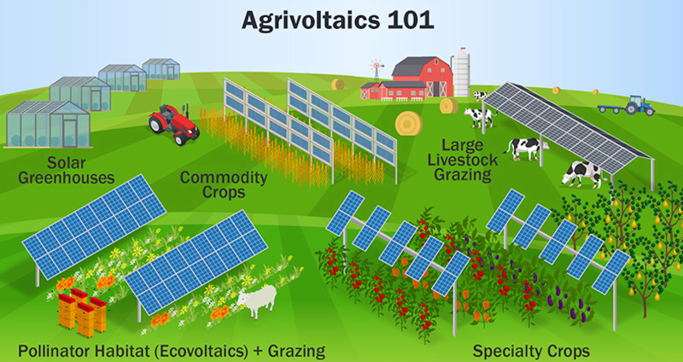
Interest in agrivoltaics has grown in Georgia as demand for renewable energy increases alongside the state’s strong agricultural economy. Agriculture contributes approximately $70 billion annually to Georgia’s economy and supports nearly 360,000 jobs, making it one of the state’s most important industries. At the same time, solar energy has become Georgia’s largest source of renewable electricity. As of June 2026, Georgia had about 7.6 GWdc installed utility-scale solar capacity, which translates to solar providing about 8% of Georgia’s total electricity generation in 2025.
As of July 2026, Georgia has 12 agrivoltaic projects with a combined capacity of 1.1 GWdc covering approximately 10,300 acres. Most of these projects combine solar panels with sheep grazing, allowing the land to produce electricity and provide needed shade to grazing animals. Although most of these projects cover large areas, common industry estimates assume that around 5 acres of buildable land can produce about one megawatt direct current (MWdc) of solar capacity. For Georgia farmers, this means that converting a portion of their land to agrivoltaics can provide modest income, allow continued agricultural development and prevent farmers from choosing between farming and solar development.
Researchers are studying how solar panels affect agricultural conditions. Solar panels can create shaded areas that alter temperatures and soil moisture levels beneath them. Scientific studies have found that, under some conditions, agrivoltaic systems can improve water-use efficiency by 20-47% and reduce temperatures beneath panels by 1-4°C (1.8-7.2°F). Researchers are continuing to evaluate how these changes affect crop yields, livestock, and farm operations in different climates and agricultural settings. Researchers with the Georgia Climate Project note that more frequent drought conditions, severe weather events, and increasing temperatures are expected to create additional challenges for Georgia’s agricultural sector in the coming decades.
Although Georgia receives around 40-52 inches of rainfall each year, drought remains a recurring challenge. The state has experienced several severe droughts in recent decades, including the 2006-2008 and 2010-2012 droughts, which affected agriculture, water supplies, and wildfire activity. Recent drought conditions have again highlighted the vulnerability of Georgia’s agricultural sector to changing weather patterns.
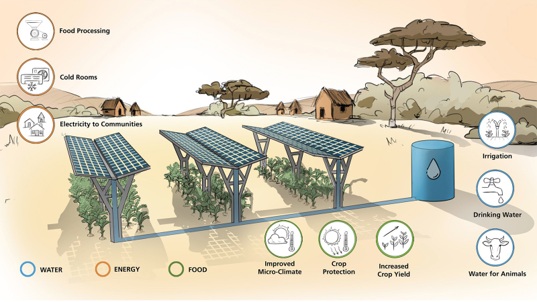
Environmental conditions can also influence public health. Extreme heat can increase the risk of heat-related illnesses. Agricultural workers and outdoor laborers may be especially vulnerable to exposure to prolonged periods of high temperatures.
Food security is another issue that affects many Georgia communities. According to Feeding America data, approximately 14.9% of Georgians (about 1 in 7 residents) experience food insecurity, including nearly 1 in 5 children. Access to affordable, nutritious food varies across the state, with some rural communities facing particularly high rates of food insecurity. To help combat food insecurity, agrivoltaics is also being examined as a way to improve land-use efficiency. Studies have shown that combining solar energy and agriculture on the same land can help farmers get more value from each acre by creating an extra source of income while still growing crops. Depending on the location and system design, these systems can increase land productivity by 20% to 80%. By potentially helping farmers to add a new revenue stream, agrivoltaics can support more resilient farming systems and contribute to long-term food security.
Although agrivoltaics has many potential benefits, it also has drawbacks. One, agrivoltaic systems often cost significantly more to build than traditional large-scale solar projects. This is because the panels may need to be mounted higher or spaced further apart to allow crops, livestock, or farm equipment to be underneath the structures. Two, not all farmland is suitable for agrivoltaics, since solar projects are generally more practical on land that is close to existing transmission lines or substations. Farms located far from infrastructure may face higher connection costs, making the project less financially feasible. Three, not all crops grow well in partial shade, so careful crop selection is important for success as agrivoltaics cannot be paired with every crop. Finally, managing both a solar energy system and an agricultural operation can be difficult, requiring additional planning, labor, and maintenance.
As Georgia continues to expand its renewable energy capacity while maintaining a strong agricultural sector, agrivoltaics is receiving increasing attention. Ongoing research is examining how these systems affect land use, agricultural productivity, water management, energy generation, ecosystems, and farm economics. While findings vary depending on local conditions, agrivoltaics represents one of several approaches being explored at the intersection of agriculture and energy production.
Below – find a 10 minute presentation on Agrivoltaics.
Overview
Historically, many solar systems were placed on disturbed and high-productivity agricultural lands, resulting in less usable acreage for farmers. Many have come to view solar as an ‘either/or’ choice: solar panels vs. farmland. The concept of agrivoltaics is one way to turn solar into a ‘yes, and’ choice. Collocating solar panels with agricultural practices, initially began in the 1980’s. It was designed as a potential solution to the concerns of climate change, limited agricultural land availability, food insecurity, and increasing water demand. Until recently, this concept was limited to growing crops while also having solar panels on the crop land. Recent innovations have expanded this practice to include grazing animals, aquatic animals, pollinator plants, native plant habitats, and greenhouses.
Currently, there are seven commonly used agrivoltaics models. These include
- Static elevated panels: Fixed panels raised above crops.
- Tracker-based systems: Panels that move to follow the sun.
- Vertical (fence-style): Panels stand upright in a row between crops or fields, like a fence.
- Greenhouse-integrated photovoltaic systems: Solar panels built into greenhouse structures.
- Movable/retractable systems: Panels that can be adjusted or removed as needed.
- Interspace systems: Panels placed in the spaces between crop rows.
- Floating solar (aquavoltaics): Panels installed on water bodies or aquatic systems.
These systems allow farmers to select the model that best fits their needs and the needs of their land. By allowing farmers to continue using their agricultural land while helping provide clean energy, agrivoltaics can be a solution to land availability and climate change concerns.
Potential Benefits
As Georgia continues to expand its renewable energy infrastructure, there is a growing interest to reduce competition between solar development and preserving farmland. Co-locating solar panels with agricultural practices, thereby reducing the competition between the two, has the potential to increase the productivity of the land. When agricultural and solar energy production complement each other, instead of competing against each other, the potential benefits of this method are far-reaching, including positive environmental, economic, and public health outcomes.
Environmental
Traditional utility-scale solar fields are intentionally kept weed and plant-free to reduce potential shading of the panels. In contrast, agrivoltaics encourages the planting of crops, pollinator species, or native species in the same space as solar panels to maximize land use efficiency by up to 73%.
Georgia’s farmers continue to face increasing challenges from extreme heat, drought, and severe weather events. Agrivoltaic systems can provide partial shade, that can reduce direct exposure to intense sunlight, lower soil temperatures, and decrease water loss through evaporation. .This can create more favorable growing conditions for certain crops (such as berries, leafy greens, forages, and root vegetables) by extending the growing season for some crops and improve yields for heat-sensitive crops like berries, fruits, and seed-bearing vegetables. Georgia’s position as a major producer of blueberries and other specialty crops makes climate adaptation strategies particularly important.
Agrivoltaics can also benefit animal husbandry due to improved forage quality and cooling from the panels’ shade during high temperatures. Georgia’s livestock operations are becoming increasingly vulnerable to increasing temperatures and heat stress. During hot summer months, livestock may experience negative impacts on growth, milk production, reproduction, feed intake, and health challenges due to the prolonged exposure to extreme heat. Solar panels can provide shade that helps reduce animal exposure to extreme heat without removing land from agricultural use.
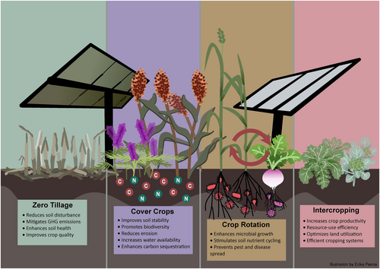
Agrivoltaics can also improve ecosystem biodiversity. By planting native and/or pollinator-friendly vegetation, this system can prevent soil erosion, support diverse local wildlife, improve water retention, and increase carbon storage yields. These benefits can be further enhanced when agrivoltaics is integrated with other conservation agricultural practices, including zero tillage, cover cropping, crop rotation, and intercropping (shown in the image below). These practices are particularly valuable in Georgia, where sporadic, unwelcome, heavy rainfall events can contribute to nutrient runoff, soil loss, and impacts on nearby waterways.
Economic and Financial Benefits
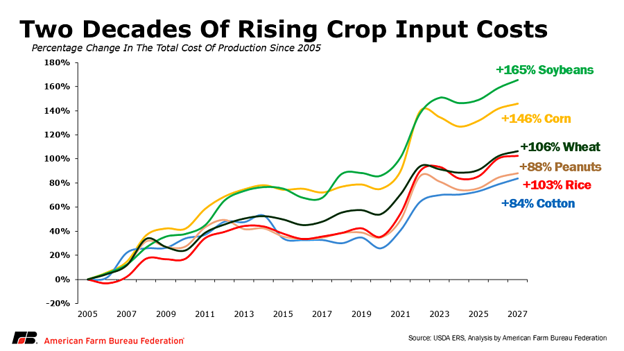
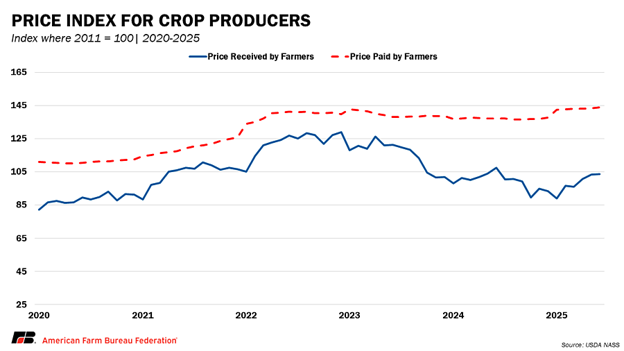
The potential economic and financial benefits are another draw to the use of agrivoltaics. Over the past 20 years, crop input costs have been on the rise, with traditional crops like soybeans showing a 165% increase in the total cost of production.
While crop inputs costs continue to rise, the price index for crop producers remains below their 2022 highs. This has placed a financial strain on many farms across the country. An April 2026 survey from the American Farm Bureau found that 78% of Southern farmers are unable to afford necessary fertilizer, which many of Georgia’s top crops (like cotton, peanuts, and corn) depend heavily upon. Additionally, 94% of respondents stated their financial situation has either remained the same or worsened. These impacts are concerning and have left many Georgia farms in dire financial situations, shown by a 145% increase in Georgia farm bankruptcies from 2024 to 2025.
With these factors causing a strong financial toll on Georgia farms, it is imperative that additional revenue streams be identified. Studies have shown that agrivoltaics is generally more profitable than agricultural revenue alone, with some studies showing it as 15 times more profitable than agricultural use alone. This method also allows farmers to diversify their income through additional revenue streams and reduced financial risks. Agrivoltaics income diversification provides a guaranteed income stream, which is especially valuable in Georgia due to the state’s vulnerability to climate-related agricultural challenges (like drought, excessive heat, hurricanes, and unpredictable rainfall). These conditions can reduce crop yields and cause large fluctuations in farm income. Agrivoltaic systems may help to provide a consistent source of revenue that can help farmers manage financial risks during years when agricultural production is negatively affected.
Beyond individual farm benefits, agrivoltaics may help to contribute to broader rural economic development throughout Georgia. The installation, operation, and maintenance of agrivoltaics systems all require skilled labor. Expanding the number of agrivoltaic systems in rural Georgia could create potential employment opportunities in construction, electrical work, and renewable energy maintenance. Additionally, agrivoltaics could help farmers generate additional revenue, allowing them to maintain their farming operations and continue employing farm workers.
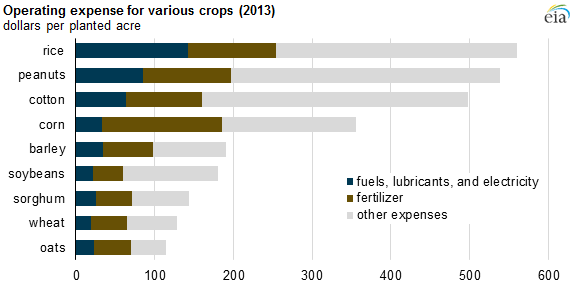
Agrivoltaics could also allow farmers to reduce their energy expenses by allowing the solar energy they generate to support their farm operations. Agricultural operations require power for many of its necessary activities (including irrigation, drying grain, refrigeration, ventilating poultry houses, water pumping, and operating various equipment). These direct energy inputs account for a large percentage of the overall operating expenses for various crops (shown in the graph).
Agrivoltaics could allow farmers to satisfy their own electrical needs, potentially resulting in decreased energy costs.
Public Health and Social Benefits
Agrivoltaics can also provide many public health benefits. For example, this practice results in less greenhouse gas emissions due to renewable energy creation and less agricultural runoff due to the reduced need for pesticides. These, in turn, result in reduced environmental pollution and potentially improved health outcomes, like fewer instances of respiratory and cardiovascular illness.
The improved yields under this system compared to traditional photovoltaic systems can also result in increased access to healthier foods. In the US, many people do not have access to fresh produce or do not have financial resources to purchase these goods. Agrivoltaics can allow farmers to continue growing crops on their land, resulting in more crop production than with traditional solar methods. This improved access to healthy produce can improve populations’ dietary patterns, improve food security, and reduce malnutrition.
Additionally, agrivoltaics can help some farmers improve their income stability by diversifying revenue streams, reducing financial pressures, and potentially mitigating mental health challenges like depression and suicide risk. This need is particularly urgent in Georgia, where farmers and agricultural workers are 3 to 5 times more likely to die by suicide compared to the general public. A recent survey found that 96% of Georgia farmers are either moderately or highly stressed, with nearly half indicating feelings of sadness or depression. Additionally, 29% of farm workers, owners, and managers reported having considered suicide in the past year. These findings underscore the need for community-based mental health interventions alongside strategies that strengthen farmers’ financial resilience, including opportunities for income diversification, like agrivoltaics.
Note: Farmers experiencing a mental health crisis or thoughts of suicide can call or text 988 or visit https://988ga.org/farmstress. The 988 Suicide & Crisis Lifeline provides free, confidential support 24/7. Georgia residents can also contact the Georgia Crisis and Access Line at 1-800-715-4225 for immediate assistance and connections to behavioral health services.
Potential Risks and Concerns
Environmental Concerns
A major concern for agrivoltaic development in Georgia is balancing renewable energy expansion with the preservation of productive farmland. Much of Georgia’s agricultural economy is concentrated in the Coastal Plain region, which contains flat, open land that is attractive for solar development. Although agrivoltaics differ from traditional utility-scale solar, poorly designed projects could still reduce agricultural productivity. Georgia farmers often use large equipment like combines, tractors, and irrigation systems to grow and harvest their crops. Solar structures that are too low, too closely spaced, or poorly positioned may interfere with planting, spraying, and harvesting crops.
Potential Mitigation Strategies:
- Develop agrivoltaic designs specifically suited for Georgia crops and large farming equipment. This could include elevated panels and wider spacing between panels.
- Create farmer-centered solar lease agreements that protect continued agricultural use and prevent unnecessary loss of farmland.
- Prioritize agrivoltaic projects on lower-productivity farmland, previously disturbed land, or areas where solar development can complement rather than replace agricultural production.
Solar development can create environmental impacts if projects are constructed without considering Georgia’s diverse ecosystems (including wetlands, forests, streams, and agricultural landscapes that support pollinators and wildlife). Solar construction activities may disturb soil, remove vegetation, increase erosion, and affect wildlife movement.
Potential Mitigation Strategies:
- Require environmental assessments before project approval, especially for sites near wetlands, streams, and conservation areas.
- Use native Georgia plant species beneath solar arrays.
- Establish pollinator-friendly vegetation plans to support bees, butterflies, and other beneficial insects.
- Avoid clearing forests and high-value habitats.
- Partner with organizations like the US Fish and Wildlife Service’s Georgia Ecological Services Field Office to study biodiversity impacts and develop best management practices.
Georgia’s climate creates both opportunities and challenges for agrivoltaics. The state experiences hot summers, periods of drought, and intense rainfall events. Solar panels may reduce evaporation and protect some crops from extreme heat, but they can also redirect rainfall and concentrate water distribution. This is especially important in South Georgia, where irrigation is essential for commonly grown crops like blueberries, peanuts, and vegetables. Improperly designed solar arrays may create concentrated runoff areas or interfere with irrigation systems.
- Conduct site-specific water assessment before installing solar arrays.
- Avoid grading the land when installing solar arrays, as this disrupts natural drainage patterns.
- Design panel layouts that maintain natural drainage patterns and reduce erosion risks.
- Use elevated solar structures that allow rainfall to evenly distribute.
- Monitor soil moisture, crop performance, and water use.
- Incorporate storm-resistant engineering standards suitable for Georgia weather conditions (ASCE 7 wind zones).
Solar panels typically last 25 to 30 years, but eventually the equipment must be replaced or removed. As solar development expands across Georgia, end-of-life management will become increasingly important. Without clear requirements, abandoned equipment or costly removal responsibilities could create financial burdens on farmers or local governments. Solar projects also require materials such as glass, metals, and electronic components that require responsible recycling or disposal. Luckily, some companies offer full solar panel recycling services.
Potential Mitigation Strategies:
- Require solar developers to provide decommissioning plans before project approval.
- Include financial guarantees or solar decommissioning surety bonds to ensure funding will be available for equipment removal and land restoration.
- Include soil restoration requirements in agricultural solar leases.
- Support recycling programs for solar panels and electronic components.
Economic Concerns
Agrivoltaics may provide new income opportunities, but access to solar development may be limited for smaller Georgia farms or farms not within 2 miles of transmission lines. The costs associated with engineering studies, permitting, construction, and financing may prevent farmers from participating. Without intentional policies, agrivoltaics could primarily benefit large landowners and external investors rather than local farms and rural communities.
Potential Mitigation Strategies:
- Expand access to grants, low-interest loans, and renewable energy assistance programs (like the Rural Energy for America Program).
- Encourage cooperative ownership models where multiple farmers share project costs and benefits.
- Develop community solar programs that allow residents and farmers to participate financially.
- Ensure solar lease agreements are reviewed by independent legal and agricultural experts.
Not all farmland is suitable for agrivoltaics. Georgia’s geographic regions differ in soil type, climate, crop production, and environmental sensitivity. An agrivoltaics project that works well in South Georgia may not be appropriate in the Piedmont or Appalachian regions.
Potential Mitigation Strategies:
- Use the Georgia Low Impact Solar Siting Tool (GA LISST) to analyze environmental sensitivities in site selection decisions.
- Evaluate soil quality, crop compatibility, and flood risk before development.
- Avoid high-value agricultural areas when alternative locations are available.
- Include Georgia farmers in site selection decisions.
Agrivoltaic projects depend on both agricultural and electricity markets, creating financial uncertainty. Georgia farmers are already facing changing commodity prices, weather risks, and increasing input costs. Solar projects can add additional uncertainty related to electricity prices, utility agreements, and future energy policies.
Potential Mitigation Strategies:
- Create long-term solar power purchase agreements (SUPAs) to provide stable and predictable revenue.
- Diversify farm income by combining agricultural production and electricity generation.
- Develop transparent contracts that explain payment structures and responsibilities.
- Use financial modeling tools (like the InSPIRE Agrivoltaics Calculator) to help evaluate potential risks and benefits.
- Monitor state energy policies through agencies such as the Georgia Public Service Commission.
Agrivoltaics may provide additional economic benefits to rural Georgia; however, benefits may not remain in local communities if projects are primarily controlled by outside companies.
Potential Mitigation Strategies:
- Develop community benefit agreements (CBAs) that provide direct local benefits.
- Encourage local hiring during construction and maintenance.
- Create revenue-sharing models (like community solar) that include farmers and surrounding communities.
- Encourage partnerships between solar developers, farmers, universities (including the Odum School of Ecology at the University of Georgia), and local governments.
- Provide public education about agrivoltaics and its impacts before project approval.
Many agricultural areas in Georgia, especially those in South Georgia, have strong solar potential but limited electrical infrastructure. Connecting rural solar projects to the power grid may require expensive transmission upgrades and lengthy approval processes.
Potential Mitigation Strategies:
- Coordinate agrivoltaic development with utility planning processes.
- Prioritize locations near existing substations and transmission infrastructure.
- Improve transparency in Georgia’s solar interconnection contracting process.
- Encourage distributed solar projects that reduce transmission losses.
- Include grid planning considerations early in site selection.
- Explicitly integrate agrivoltaics into utility long-term Integrated Resource Plans (IRPs).
Community and Policy Concerns
Community acceptance is a critical factor in determining the success of agrivoltaic projects. Many rural communities have strong connections to farming and may worry that solar development could change local landscapes, reduce available farmland, reduce property values, or change the character of their communities. Acceptance can help navigate local zoning laws, ensure food system continuity, and align land-use goals.
Potential Mitigation Strategies:
- Involve communities early in the planning process.
- Hold public meetings to explain project benefits and concerns.
- Provide clear information about land use, environmental impacts, and economic benefits.
- Create community benefit agreements (CBAs) that provide local benefits like jobs, infrastructure improvements, or community funding.
- Encourage collaboration between Georgia farmers, developers, local governments, and organizations like the University of Georgia Cooperative Extension.
Because there is no single statewide agrivoltaic permitting process in Georgia, requirements can vary between counties. Some rural counties may not have the staff or technical knowledge needed to evaluate larger solar projects and their effects on agriculture, the environment, and local communities.
Potential Mitigation Strategies:
- Create statewide guidance for responsible agrivoltaic development.
- Provide training and resources (like the Center for Rural Affairs’ Agrivoltaics Toolkit) for county officials.
- Develop consistent standards for agriculture, stormwater management, environmental protection, and land restoration.
- Improve coordination between local governments, the Georgia Department of Agriculture, and solar developers.
- Include agricultural protections in local solar regulations.
Financial incentives can help encourage agrivoltaic development, but they should benefit Georgia farmers and communities, not only solar companies. Existing initiatives from organizations like the U.S. Department of Agriculture can help reduce costs, but additional protections are needed for farmers.
Potential Mitigation Strategies:
- Prioritize incentives for projects that continue agricultural production.
- Require projects to demonstrate agricultural benefits.
- Encourage designs that protect soil health, biodiversity, and farmland.
- Include farmer protections (like clear dual-use rights, soil protection mandates, liability caps, and decommissioning bonds) in solar lease agreements.
- Use farmland preservation agreements (Like the Agricultural Conservation Easement Program, ACEP) to protect agricultural land.
Conclusion
Suggestions
Recent surveys show that up to 70% of farmers are open to engaging in agrivoltaics, indicating an increasing desire to implement these systems. With this increasing interest, it is important to keep current best practices in mind. One of these considerations is site selection. As agrivoltaics requires cleared land, agrivoltaics should only be established on already disturbed land rather than undisturbed ecosystems like forests. Since farmland is already disturbed, agrivoltaics can improve the diversity of these ecosystems, but will negatively affect the ecosystem of previously undisturbed land.
It has also been suggested to have high-mount systems that are raised 8-12 feet to allow full access to farm equipment. Another suggestion is to have solar panels cover 60% of the land to get the best benefit ratio. In addition to careful consideration of the site selection process, consideration of the local community and stakeholders should be given. Eliciting stakeholder input and participation in the development process early improves community support and problem-solving.
To support the growing demand for agrivoltaic and renewable energy projects, workforce development opportunities should also be expanded. Local Technical College System of Georgia (TCSG) institutions like Savannah Technical College and Central Georgia Technical College have begun providing North American Board of Certified Energy Practitioners (NABCEP) certificate programs. These programs prepare students with the technical skills needed for solar installation, maintenance, and system management.
Further development of these training pathways can create a skilled local workforce, support rural economic development, and ensure communities have qualified professionals available to implement and maintain agrivoltaic systems.
Conclusion
Agrivoltaics is a way to meet emerging community needs. Concerns about sustainable food production and the demand for renewable energy infrastructure are growing by the day. This method maximizes land-use efficiency and helps to address food shortages. Agrivoltaics also has the potential to provide additional economic opportunities for farmers and rural communities. Therefore, importance should be placed on continued research, policy support, and implementation of these practices.