
“Forever Chemicals” have been in the news a lot lately. Below is some information on what they are and why their presence is a health concern.
Composition of PFAS
Per- per-and polyfluoroalkyl substances (PFAS) are class of chemicals used since the 1950’s to make products resistant to heat, oil, stains, grease, and water. PFAS are widely used as coatings are on a variety of products, including furniture, food packaging, and electrical wire insulation.
PFAS are created by joining carbon and fluorine. This chemical bond is very strong, giving PFAS its desirable properties, but also makes them slow to break down.
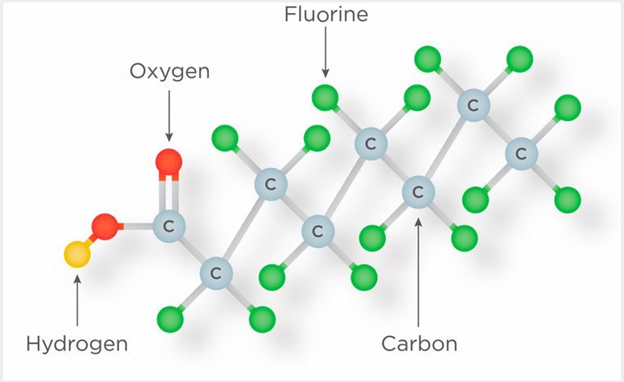
PFAS and Human Health
Humans are exposed to PFAS through the food they eat, the water they drink, and the products they use. This exposure impacts human health.
PFAS are everywhere and are a concern to human and environmental health for several reasons.
- PFAS are “forever chemicals.” They remain in the environment and do not break down.
- PFAS are circulated through soils and water which can contaminate drinking water sources.
- This circulation causes PFAS to build up, or bioaccumulate, in fish and wildlife, which may later be consumed.
Research involving human subjects suggest that high levels of PFAS may lead to increased cholesterol levels, decreased vaccine response in children, changes in liver enzymes, increased risk of high blood pressure or pre-eclampsia in pregnant women, decreases in infant birth weights, and increased risk of kidney or testicular cancer. Additional research is needed to understand the dose-response relationship of ever-growing PFAS in the environment and human health.

Risk for Georgians
Georgians are especially at risk for PFAS exposure. Scientists have tested more than 100 water treatment plants in north Georgia and found PFAS, among other chemicals linked to cancer and other serious illnesses. Twenty of these sites had PFAS levels about the EPA’s existing threshold. This is likely because of a manufacturing plant located in Dalton, GA that has produced 90% of the world’s carpet and uses PFAS to make fibers more stain resistant. Chemical waste from this plant is treated at the facility, and deposited into the Conasuaga River (an hour and a half north of Atlanta). As one of the most biodiverse river systems in North America, experts are concerned of the impact of PFAS on the ecosystem as well as those who rely on it for drinking water.
In 2023, a major lawsuit was settled in North Georgia around PFAS exposure in drinking water.
Emory researchers respond to community PFAS concerns in northwest Georgia – 20 Feb 2025

Future Regulation
Historically, PFAS have not been regulated by the EPA. However, in October of 2021, the Biden EPA Administrator Michael Regan announced a PFAS strategic roadmap, which sets a four year timeline by which EPA plans to take specific actions. This roadmap outlined actions across three central directives:
- Research: Invest in research, development, and innovation to increase understanding of PFAS exposures and toxicities, human health and ecological effects, and effective interventions that incorporate the best available science.
- Restrict: Pursue a comprehensive approach to proactively prevent PFAS from entering air, land, and water at levels that can adversely impact human health and the environment.
- Remediate: Broaden and accelerate the cleanup of PFAS contamination to protect human health and ecological systems.
Take Action
The current scientific evidence supports prevention, regulation, and cleanup of PFAS chemicals. Write your legislator to share your input and thoughts on how we should address PFAS.
In 2024, HB 611 Forever Chemicals (PFAS) Transparency Act was introduced. Under current law, industries that use these chemicals do not have to disclose their use to the municipal treatment plants where wastewater is sent to be treated. Thus, PFAS is getting into our water and soil without our knowledge. HB 611 closes this information gap by requiring industries to disclose when they are sending PFAS to municipal wastewater treatment plants – allowing those utilities to effectively do their jobs. Introduced.
Sources
Due to the inconsistency of federal information around this issue – many fact sheets from the Environmental Protection Agency (EPA), Centers for Disease Control (CDC), and the National Institutes of Health (NIH) are no longer online and/or trustworthy.
The above information was sourced from those agencies in 2021. Below we provide a list of academic sources that corroborate these statements. We welcome suggestions for more resources.
Suzanne E. Fenton, Alan Ducatman, Alan Boobis, Jamie C. DeWitt, Christopher Lau, Carla Ng, James S. Smith, Stephen M. Roberts. Per‐ and Polyfluoroalkyl Substance Toxicity and Human Health Review: Current State of Knowledge and Strategies for Informing Future Research | Environmental Toxicology and Chemistry. Environmental Toxicology and Chemistry, Volume 40, Issue 3, 1 March 2021, Pages 606–630.
Zunaira Habib, Minkyung Song, Sadaf Ikram, Zahra Zahra. Overview of Per- and Polyfluoroalkyl Substances (PFAS), Their Applications, Sources, and Potential Impacts on Human Health. Pollutants 2024, 4(1), 136-152;
Naima Hamid, Muhammad Junaid, Rakia Manzoor, Marriya Sultan, Ong Meng Chuan, Jun Wang. An integrated assessment of ecological and human health risks of per- and polyfluoroalkyl substances through toxicity prediction approaches. Science of the Total Environment. 20 Dec, 2023.
Gaurav Jha, Vanaja Kankarla, Everald McLennon, Suman Pal, Debjani Sihi, Biswanath Dari, Dawson Diaz, Mallika Nocco. Per- and Polyfluoroalkyl Substances (PFAS) in Integrated Crop–Livestock Systems: Environmental Exposure and Human Health Risks. Int. J. Environ. Res. Public Health 2021, 18(23), 12550;
Emiliano Panieri, Katarina Baralic, Danijela Djukic-Cosic, Aleksandra Buha Djordjevic, Luciano Saso. PFAS Molecules: A Major Concern for the Human Health and the Environment. Toxics 2022, 10(2), 44;